AI is no longer just a feature that businesses experiment with.
In 2026, artificial intelligence is becoming part of the core architecture of modern applications—from customer support and healthcare platforms to fintech, eCommerce, logistics, education, and enterprise software.
The biggest shift is simple:
AI apps are moving from “answering questions” to understanding context, making decisions, using tools, and completing tasks.
That change is creating a new generation of intelligent applications.
According to Gartner, worldwide AI spending is forecast to reach $2.59 trillion in 2026, representing a 47% year-over-year increase. Gartner also expects enterprises to expand their use of AI agents across workflows.
So, what does this mean for businesses planning an AI application?
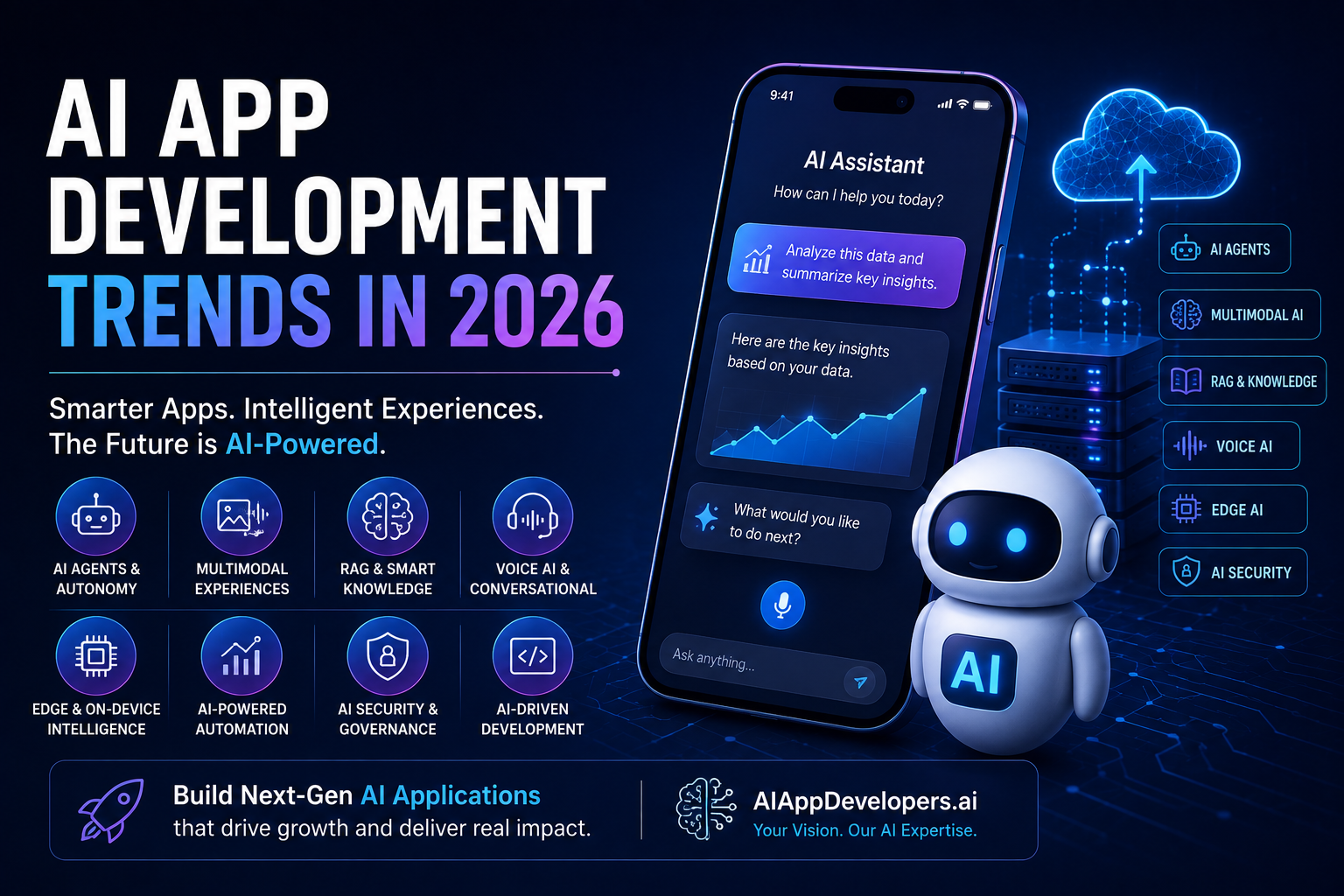
Let’s explore the biggest AI app development trends in 2026.
1. AI Agents Are Becoming the New Application Layer
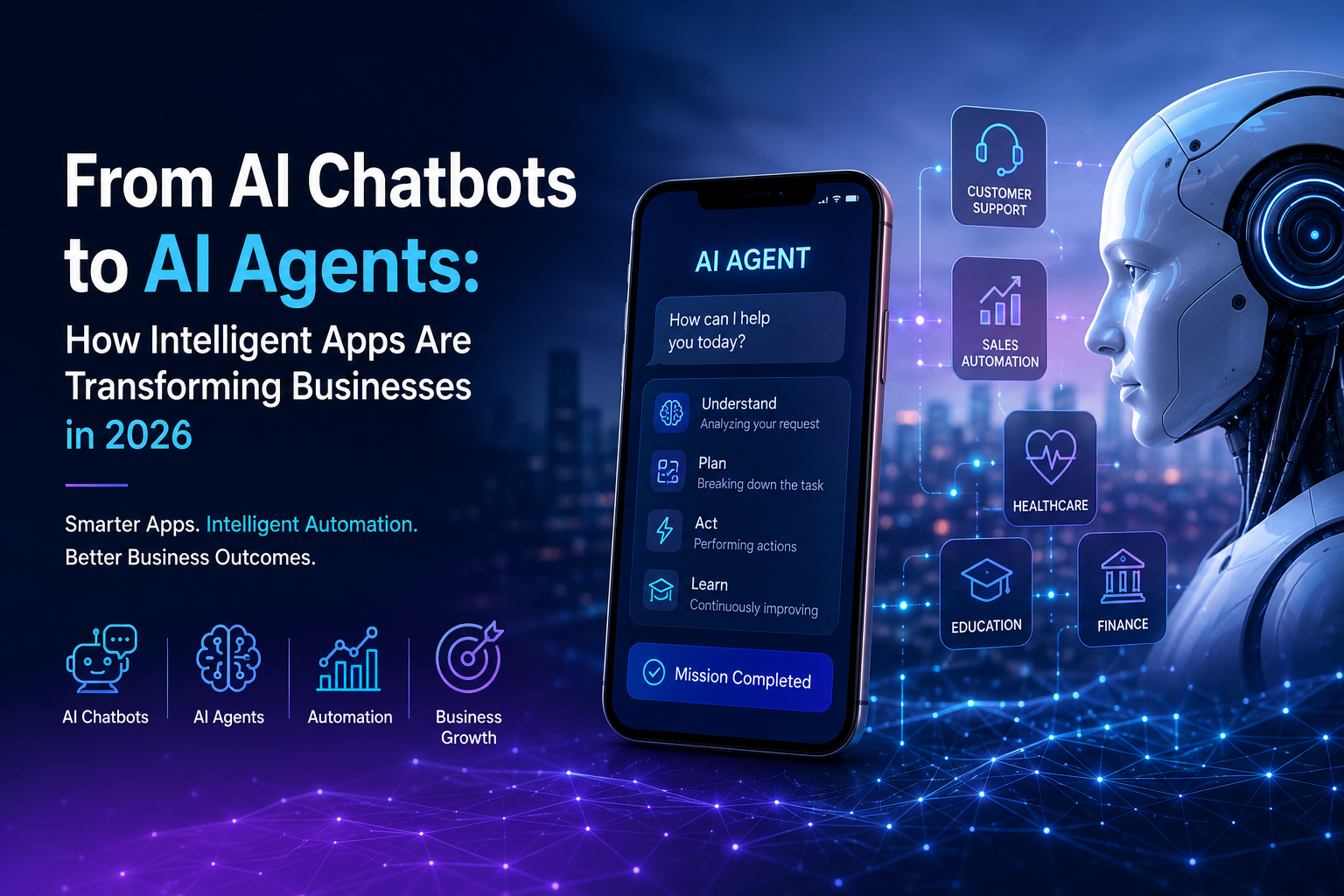
One of the biggest trends in AI application development is the rise of agentic AI.
Traditional AI applications generally work like this:
User → Prompt → AI → Response
AI agents can work more like:
Goal → Planning → Tools → Actions → Results → Feedback
Instead of simply telling a customer how to complete a task, an AI agent could potentially perform multiple steps on the user’s behalf.
For example, an AI travel application could:
- Understand the user’s travel requirements.
- Search available options.
- Compare prices.
- Create an itinerary.
- Ask for approval.
- Complete an authorized booking workflow.
This is why businesses are increasingly exploring AI agent development instead of building simple chatbot experiences.
Gartner’s 2026 research highlights orchestrators, autonomous workflows, and real-time reasoning as important areas for organizations exploring agentic AI.
What this means for businesses
If you’re planning an AI application in 2026, don’t ask only:
“Where can we add a chatbot?”
Ask:
“Which business workflow could AI understand, automate, and improve?”
That question can lead to significantly more valuable AI products.
2. Multimodal AI Is Changing User Experiences
AI applications are no longer limited to text.
Modern AI systems can increasingly work with multiple types of information, including:
- Text
- Images
- Audio
- Video
- Documents
- Structured business data
This is known as multimodal AI.
Imagine a healthcare application where a user can upload a medical document, ask a voice question, and receive an explanation.
Or consider an eCommerce application where customers can upload a product image and ask:
“Find something similar in my budget.”
These experiences are difficult to create with traditional text-only AI.
Multimodal capabilities are therefore becoming an important consideration for businesses building next-generation AI applications.
Gartner’s 2026 research on AI application development platforms specifically identifies multimodal applications alongside AI assistants, agents, orchestration, observability, security, and model management as important capabilities.
3. AI Copilots Are Moving Into Business Software
Not every business needs a fully autonomous AI agent.
For many organizations, the better solution is an AI copilot.
An AI copilot works alongside employees and customers rather than completely replacing their workflows.
Examples include:
Sales Copilot
Helps sales teams summarize customer conversations, identify opportunities, and prepare follow-ups.
Customer Support Copilot
Summarizes conversations and suggests responses to support representatives.
Developer Copilot
Helps developers understand code, generate solutions, write tests, and troubleshoot problems.
Finance Copilot
Helps analyze reports, transactions, and financial information.
HR Copilot
Can help employees find company policies, summarize documents, and answer internal questions.
This makes AI copilots particularly attractive for enterprise AI app development.
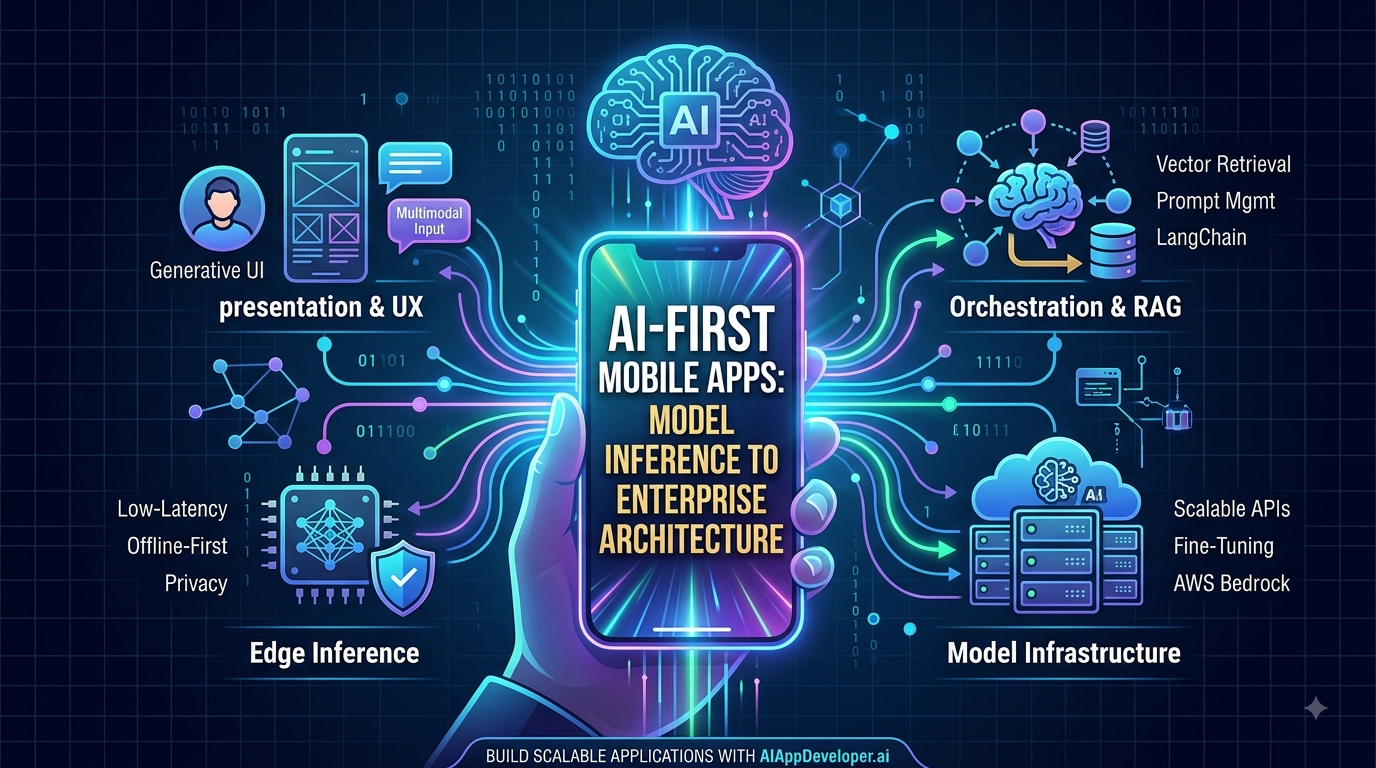
4. AI Is Becoming Part of the Core Application Architecture
Earlier AI implementations often looked like:
Existing App + AI Feature
In 2026, businesses are increasingly considering:
AI-Native Application Architecture
The difference is significant.
Instead of adding AI at the end, developers can design the application around AI from the beginning.
That can influence:
- Data architecture
- APIs
- User experience
- Authentication
- Model selection
- Retrieval systems
- Agent orchestration
- Monitoring
- Security
- Cost management
This approach can make AI a fundamental part of the product rather than a decorative feature.
5. RAG Is Becoming More Sophisticated
Retrieval-Augmented Generation (RAG) remains an important technique for enterprise AI applications.
A basic RAG system works by retrieving relevant information from a knowledge base and providing that information to an AI model before generating a response.
For example:
Company Documents → Search/Retrieval → Relevant Information → AI Model → Answer
This is particularly useful for:
- Internal knowledge assistants
- Customer support
- Legal document search
- Healthcare information systems
- Enterprise documentation
- Product support
- Financial research
But RAG in 2026 is increasingly about more than simply searching documents.
Businesses need to think about:
- Data quality
- Retrieval accuracy
- Access permissions
- Context management
- Evaluation
- Observability
- Security
- Freshness of information
Gartner’s guidance on building agentic AI specifically highlights data readiness and retrieval foundations as important factors for reliable production systems.
6. AI Apps Are Becoming More Personalized
People don’t want generic AI experiences.
They want applications that understand their:
- Preferences
- History
- Goals
- Behavior
- Context
For example, an AI fitness application could use previous activity to personalize recommendations.
An education application could adapt lessons according to a student’s progress.
An eCommerce application could personalize product discovery based on previous purchases.
Personalization can make an AI application significantly more useful—but it also creates important requirements around data privacy, consent, security, and access control.
7. Voice AI Is Becoming a Major Interface
Typing isn’t always the most convenient way to interact with software.
Voice-enabled AI applications can make interactions more natural.
Potential use cases include:
- Voice customer support
- AI receptionists
- Healthcare assistants
- Sales assistants
- Automotive applications
- Field-service applications
- Voice-controlled productivity tools
- Personal assistants
A modern voice AI application may combine:
Speech Recognition + AI Reasoning + Business APIs + Text-to-Speech
The result can feel less like using traditional software and more like having a conversation with an intelligent digital assistant.
8. On-Device and Edge AI Are Growing
Not every AI task needs to happen in the cloud.
Some applications benefit from running AI directly on devices.
This can provide advantages such as:
- Lower latency
- Better privacy
- Reduced network dependency
- Faster responses
- Offline functionality
- Lower cloud processing requirements
This is particularly relevant for:
- Smartphones
- Wearables
- IoT devices
- Automotive systems
- Industrial equipment
- Smart cameras
- Healthcare devices
The future is therefore likely to involve a combination of:
Cloud AI + Edge AI + On-Device AI
Developers need to decide where each AI task should run based on performance, privacy, cost, and hardware capabilities.
9. Small and Specialized AI Models Are Becoming More Important
Bigger models aren’t automatically better for every application.
A business may not need the largest available model for a simple classification, extraction, recommendation, or automation task.
Smaller specialized models can potentially provide:
- Lower latency
- Lower inference costs
- Easier deployment
- Better privacy options
- More predictable performance
This creates an important architecture decision:
Which model is appropriate for each task?
A sophisticated AI application may use multiple models instead of relying on one model for everything.
10. AI Model Orchestration Is Becoming Essential
Imagine an application that receives a customer request.
One model might classify the request.
Another might retrieve company information.
Another system might perform calculations.
An AI agent might then decide which business API to call.
The final response could be generated by another model.
This creates an orchestration layer.
A simplified architecture could look like:
User → AI Router → Model/RAG/Tool → Business API → AI Response
As AI applications become more sophisticated, orchestration becomes increasingly important.
11. AI + APIs Will Create More Action-Oriented Applications
An AI application becomes significantly more useful when it can interact with existing business systems.
For example:
AI + CRM
The AI can access authorized customer information.
AI + ERP
The AI can help analyze inventory and operations.
AI + POS
The AI can analyze sales and provide business insights.
AI + Calendar
The AI can help manage schedules.
AI + Payment Systems
The AI can assist with authorized payment workflows.
This means AI app development is increasingly about integrating intelligence with existing software infrastructure.
The AI model itself is only one component.
12. AI-Powered Automation Is Moving Beyond Chatbots
Businesses have spent years deploying chatbots.
The next stage is workflow automation.
Consider customer support.
A traditional chatbot may answer:
“Where is my order?”
An AI-powered workflow could potentially:
- Identify the customer.
- Find the order.
- Check shipping status.
- Identify a delay.
- Create a support ticket if required.
- Notify the customer.
- Escalate the case when necessary.
The important difference is action.
AI applications are increasingly being designed to connect intelligence with business processes.
13. AI Security and Governance Are Becoming Critical
More AI capability also means more responsibility.
Businesses need to consider:
- Data privacy
- Access control
- Prompt injection
- Model misuse
- Data leakage
- Authentication
- Audit trails
- AI hallucinations
- Model monitoring
- Human oversight
An AI agent with access to business systems needs stronger controls than a simple public chatbot.
AI security should therefore be included during architecture and development rather than added after deployment.
14. AI Observability Is Becoming a Must-Have
Traditional applications can be monitored through logs, metrics, and traces.
AI applications introduce additional questions:
- Why did the model produce this answer?
- Which data was retrieved?
- Which tool did the agent call?
- How much did the request cost?
- How long did inference take?
- Was the response accurate?
- Did the agent complete the task correctly?
AI observability helps development teams monitor these issues.
For production AI applications, teams should consider:
Performance + Accuracy + Cost + Security + Reliability
rather than monitoring server uptime alone.
15. AI Application Development Platforms Are Maturing
Developers now have access to an increasingly broad ecosystem for building AI applications.
Modern AI development platforms can provide capabilities for:
- AI assistants
- AI agents
- Multimodal applications
- Model management
- RAG
- Orchestration
- Evaluation
- Observability
- Security
- Deployment
This is making AI development more accessible, but it also creates another challenge:
Choosing the right architecture and technology stack.
The fastest development platform isn’t always the best platform for a production application.
16. AI Coding Agents Are Changing Software Development
AI isn’t only changing the applications developers build.
It is changing how developers build them.
AI coding agents can assist with:
- Code generation
- Debugging
- Testing
- Documentation
- Refactoring
- Code analysis
- Pull requests
- Development workflows
Research published in 2026 examining AI-authored pull requests in Android and iOS open-source projects found meaningful adoption of AI coding agents, with differences across platforms and task types.
However, AI-generated code still requires human review.
Businesses should treat AI coding tools as development accelerators—not replacements for engineering practices.
17. AI + IoT Will Create Smarter Applications
The combination of AI and connected devices opens another major opportunity.
Imagine:
IoT Sensors → Real-Time Data → AI Analysis → Automated Action
Potential applications include:
- Smart buildings
- Predictive maintenance
- Healthcare monitoring
- Industrial automation
- Smart retail
- Fleet management
- Energy optimization
- Agriculture
AI can turn raw sensor data into predictions, recommendations, and automated decisions.
For companies already investing in IoT, adding AI can create a much more intelligent technology ecosystem.
18. AI Applications Will Become More Industry-Specific
Generic AI is useful.
But specialized AI can be much more valuable.
In 2026, we’re seeing increasing opportunities for vertical AI applications in areas such as:
Healthcare AI
Patient support, documentation, scheduling, medical information workflows, and operational automation.
Fintech AI
Fraud detection, financial analysis, customer support, risk workflows, and automation.
Retail AI
Personalization, demand forecasting, inventory intelligence, and customer engagement.
Real Estate AI
Property search, lead qualification, document analysis, and customer communication.
Education AI
Personalized learning, tutoring, assessment, and educational content.
Logistics AI
Route optimization, forecasting, fleet intelligence, and automated operations.
The winning AI application may not be the one with the most features.
It may be the one that solves a specific industry problem exceptionally well.
How Businesses Should Approach AI App Development in 2026
With so many AI technologies available, businesses can easily fall into the “AI for everything” trap.
A better approach is to start with the business problem.
Step 1: Identify the Problem
What process is expensive, slow, repetitive, or difficult?
Step 2: Identify the AI Opportunity
Ask whether AI can realistically improve the process.
Step 3: Define the User
Who will use the AI application?
Customers?
Employees?
Managers?
Partners?
Step 4: Choose the Right AI Architecture
Decide whether you need:
- AI chatbot
- AI copilot
- RAG application
- AI agent
- Multimodal AI
- Voice AI
- Predictive AI
- AI + IoT
- A combination of these
Step 5: Build an MVP
Don’t try to build the entire AI ecosystem at once.
Start with the highest-value workflow.
Step 6: Evaluate
Measure:
- Accuracy
- User satisfaction
- Response time
- Cost
- Task completion
- Business ROI
Step 7: Scale
Once the AI application proves its value, expand the workflows and integrations.
How Much Does AI App Development Cost in 2026?
There is no universal price for AI application development.
The cost depends on:
- Application complexity
- AI model selection
- Number of AI features
- RAG requirements
- Agent architecture
- Mobile/web platforms
- Backend complexity
- API integrations
- Data requirements
- Security
- Cloud infrastructure
- AI training or fine-tuning
- Testing
- Ongoing maintenance
A basic AI-powered application can be significantly less complex than an enterprise AI platform with multiple agents, databases, APIs, and real-time data.
The smartest approach is to define the MVP and technical architecture before estimating the complete project.
Should You Build an AI App or Add AI to an Existing App?
This depends on your business.
If you already have a successful application, adding AI may be the fastest route.
For example:
Existing CRM + AI Copilot
Existing eCommerce + AI Recommendation Engine
Existing POS + AI Analytics
Existing Healthcare App + AI Assistant
But if AI is central to the product itself, building an AI-native application may make more sense.
AI App Development Trends: What Matters Most?
There are dozens of AI trends in 2026.
But businesses don’t need to adopt all of them.
The most important trends to watch are:
- Agentic AI
- Multimodal AI
- AI copilots
- RAG and enterprise knowledge systems
- AI-powered automation
- Voice AI
- On-device AI
- Smaller specialized models
- AI + APIs
- AI security and governance
- AI observability
- AI + IoT
- Industry-specific AI
- AI-assisted software development
The bigger trend connecting all of these is the move from AI that generates information to AI that helps complete real-world work.
Why Work With an AI App Development Company?
Building an AI application isn’t simply about connecting an API to an attractive user interface.
A production-ready AI application requires decisions around:
- User experience
- AI architecture
- Model selection
- Data pipelines
- RAG
- Agent orchestration
- APIs
- Cloud infrastructure
- Security
- Evaluation
- Monitoring
- Scalability
An experienced AI app development team can help turn an idea into a practical product architecture.
Build Your AI Application With AIAppDevelopers.ai
At AIAppDevelopers.ai, businesses can work with an experienced AI application development team to turn AI ideas into production-ready applications.
AI development services can include:
- Custom AI app development
- Generative AI development
- AI chatbot development
- AI agent development
- AI copilot development
- RAG application development
- Machine learning solutions
- Computer vision applications
- Voice AI development
- Multimodal AI applications
- AI API integration
- AI-powered mobile apps
- AI-powered web applications
- AI + IoT solutions
- AI consulting and strategy
Whether you want to add AI to an existing product or build a completely new AI-native application, the right architecture can make the difference between an impressive demo and a reliable business product.
Frequently Asked Questions
What are the biggest AI app development trends in 2026?
The biggest trends include agentic AI, multimodal applications, AI copilots, RAG, AI automation, voice AI, on-device AI, specialized models, AI security, AI observability, and industry-specific AI applications.
Is AI app development worth investing in 2026?
For businesses with a clear use case, AI can improve automation, customer experience, personalization, decision-making, and operational efficiency. The strongest investments typically start with a measurable business problem rather than AI technology alone.
What is an AI agent?
An AI agent is a system designed to pursue a goal by reasoning through tasks, using tools or external systems, and taking actions with varying levels of human oversight.
What is the difference between an AI chatbot and an AI agent?
A chatbot primarily responds to user inputs. An AI agent can potentially plan and execute multi-step tasks using tools, APIs, and business systems.
How much does it cost to develop an AI app?
AI app development costs vary significantly depending on features, architecture, integrations, AI models, data requirements, security, and scalability. A discovery and architecture phase is the best way to create a realistic estimate.
Can AI be added to an existing mobile application?
Yes. AI can be integrated into existing Android, iOS, Flutter, React Native, and web applications through APIs, SDKs, backend services, or on-device models.
Can AI applications work with company data?
Yes. Techniques such as RAG can allow AI applications to retrieve relevant information from authorized business data sources. Security, permissions, data quality, and governance should be designed into the system.
Final Thoughts
The biggest AI app development trend in 2026 isn’t a particular model or framework.
It’s a change in what people expect software to do.
Applications are becoming more intelligent, more conversational, more personalized, and more capable of completing tasks.
The next generation of successful applications won’t simply say:
“Here is the information you requested.”
They will increasingly say:
“I understand what you’re trying to accomplish. Here’s what I can do to help.”
For businesses, that creates enormous opportunities—but also makes architecture, security, data, and user experience more important than ever.
If you have an AI application idea, the best time to validate it is before investing heavily in development.
Have an AI app idea? Let’s turn it into a real product.
Talk to the AI application development team at AIAppDevelopers.ai and start planning your AI solution for 2026.