Artificial intelligence has moved far beyond the traditional chatbot.
In 2026, businesses are increasingly looking at AI applications that can understand context, interact with business systems, use tools, and complete multi-step tasks.
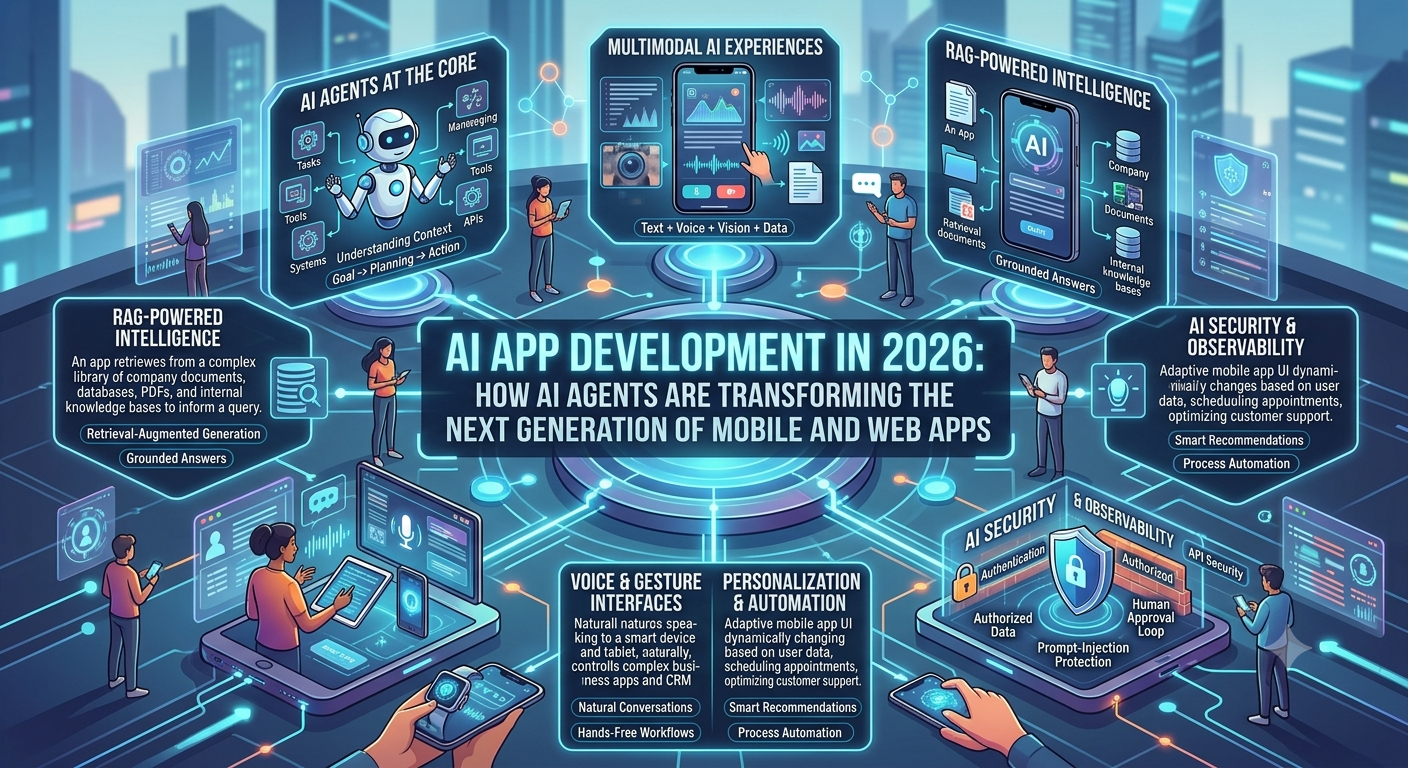
This shift is creating a new generation of intelligent applications powered by AI agents, generative AI, multimodal AI, voice interfaces, and intelligent automation.
For businesses planning a new digital product, the question is no longer simply:
“Should we add AI to our application?”
The better question is:
“What can our application accomplish when AI becomes part of its core architecture?”
What Is AI App Development?
AI app development involves building mobile, web, or enterprise applications that use artificial intelligence to perform tasks that traditionally required manual effort or rule-based programming.
AI applications can use technologies such as:
- Generative AI
- Large language models
- Machine learning
- Natural language processing
- Computer vision
- Speech recognition
- Recommendation engines
- AI agents
- Retrieval-Augmented Generation (RAG)
- Predictive analytics
The goal is not simply to add an AI chatbot to an existing application. Modern AI app development focuses on creating useful experiences where AI becomes part of the application’s functionality and workflow.
The Biggest AI App Development Shift in 2026
One of the most important changes is the move from AI that answers to AI that acts.
Traditional AI applications often follow this model:
User → Prompt → AI → Response
Agent-powered applications can follow a more advanced workflow:
Goal → Planning → Tools → Actions → Results → Feedback
AI agents can handle longer, multi-step tasks and interact with tools and systems rather than simply generating a response. OpenAI describes this shift as moving knowledge work from individual interactions toward delegated, longer-horizon tasks.
This creates significant opportunities for businesses building new AI applications.
1. AI Agent Development
AI agents are becoming an important part of modern application architecture.
An AI agent can be designed to:
- Understand a user’s goal
- Break a task into steps
- Access authorized data
- Use APIs and business tools
- Make decisions within defined boundaries
- Complete workflows
- Report results to users
For example, an AI sales application could analyze a lead, research relevant information, prepare a personalized message, update a CRM, and notify a sales representative.
Instead of simply providing information, the application can help execute the workflow.
2. Multimodal AI Applications
Modern AI applications are becoming increasingly multimodal.
Instead of working only with text, applications can combine:
Text + Images + Audio + Video + Documents + Business Data
This opens the door to new types of user experiences.
For example, an eCommerce application could allow a customer to upload a product image and ask:
“Find similar products under my budget.”
A field-service application could allow a technician to photograph equipment, ask a voice question, and receive AI-generated troubleshooting guidance based on company documentation.
Multimodal capabilities are becoming an important part of next-generation AI application development.
3. Voice AI Is Becoming a New App Interface
Typing isn’t always the most convenient way to interact with an application.
Voice AI can make applications more natural and accessible.
Businesses can develop:
- AI voice assistants
- Voice customer-support applications
- AI appointment assistants
- Voice-enabled healthcare applications
- AI sales assistants
- Voice-based learning applications
- Hands-free enterprise applications
Users can communicate naturally while the application processes their request and performs authorized actions.
4. RAG-Powered AI Applications
Businesses often want AI applications to work with their own information.
This is where Retrieval-Augmented Generation (RAG) becomes valuable.
A simplified RAG workflow looks like this:
User Question → Knowledge Search → Relevant Information → AI Model → Response
An AI application can potentially retrieve information from:
- Company documents
- PDFs
- Product catalogs
- Websites
- Databases
- Knowledge bases
- Support documentation
- Internal policies
This can help businesses create AI assistants that are grounded in their own information rather than relying only on a general-purpose model.
5. AI-Powered Personalization
Personalization is another major opportunity for AI applications.
Instead of showing every user the same experience, an AI-powered application can analyze permitted user data and interactions to provide more relevant experiences.
Examples include:
- Personalized product recommendations
- Customized learning paths
- AI-generated content
- Personalized marketing
- Smart search
- Customer-specific recommendations
- Adaptive user interfaces
For businesses, personalization can make digital products more useful and engaging.
6. AI for Business Automation
Many organizations still rely on repetitive manual processes.
AI applications can help automate parts of workflows such as:
- Customer support
- Document processing
- Lead qualification
- Data analysis
- Report generation
- Appointment scheduling
- Employee assistance
- Content creation
- Internal knowledge search
Google Cloud’s 2026 AI agent research highlights the growing use of agents for complex workflows rather than isolated prompts.
The biggest opportunity is not automating everything.
It is identifying the right processes where AI can deliver measurable value while keeping appropriate human oversight.
7. AI-Powered Mobile Apps
AI is becoming an important component of mobile application development.
AI can be integrated into both iOS and Android applications to provide features such as:
- Intelligent search
- AI chat
- Voice interaction
- Image analysis
- Personalized recommendations
- Smart notifications
- AI assistants
- Predictive features
- Automated workflows
Developers can also combine AI with technologies such as React Native, Flutter, Swift, Kotlin, cloud APIs, and backend services to build scalable AI-powered mobile experiences.
8. AI Application Security Is Critical
More capable AI applications also introduce new security challenges.
An AI agent may interact with APIs, databases, files, business systems, or external tools. That means developers need to carefully control what an AI system can access and what actions it is allowed to perform.
Important considerations include:
- Authentication
- Authorization
- Data encryption
- API security
- Role-based access
- Tool permissions
- Audit logging
- Human approval workflows
- Prompt-injection protection
- Monitoring
- Data privacy
As AI agents become more autonomous, security and observability need to be designed into the application architecture rather than added later. Recent industry research highlights these challenges around production agentic AI.
How to Build a Successful AI Application
Building an AI app should start with the business problem—not the AI model.
Step 1: Identify the Problem
Determine which business or customer problem the application needs to solve.
Step 2: Define the AI Use Case
Decide whether AI should be used for prediction, generation, search, automation, personalization, conversation, or agentic workflows.
Step 3: Choose the Right AI Architecture
Depending on the use case, the application may require:
- LLM integration
- RAG
- AI agents
- Machine learning
- Computer vision
- Voice AI
- Multiple AI models
Step 4: Design the User Experience
AI should make the application easier to use—not more complicated.
Step 5: Integrate Business Systems
Connect the AI application with authorized APIs, databases, CRM systems, payment systems, or other required platforms.
Step 6: Test and Monitor
AI applications require testing for accuracy, reliability, security, latency, cost, and unexpected behavior.
Step 7: Continuously Improve
AI applications should evolve based on real user feedback, performance data, and changing business requirements.
What Will AI Apps Look Like in the Future?
The next generation of applications will likely become increasingly intelligent and proactive.
Instead of opening several applications and manually completing a series of tasks, users may increasingly interact with an AI-powered interface that coordinates multiple services.
For businesses, this means applications can evolve from:
Software that users operate
to:
Software that helps users accomplish goals.
That is one of the most important changes happening in application development.
Why Businesses Should Invest in AI App Development
AI can create opportunities to improve:
- Customer experience
- Operational efficiency
- Employee productivity
- Decision-making
- Personalization
- Automation
- Product differentiation
- Business scalability
But successful AI development requires more than simply connecting an application to an AI API.
Businesses need the right combination of product strategy, UX design, AI architecture, software engineering, security, integrations, testing, and ongoing optimization.
Build Your Next AI-Powered Application
The future of software is becoming increasingly intelligent.
Whether you are planning an AI mobile app, AI web application, AI chatbot, AI assistant, RAG application, voice AI solution, computer vision application, or autonomous AI agent, choosing the right architecture is critical.
At AIAppDevelopers.ai, the focus is on helping businesses turn AI ideas into practical, scalable applications.
From initial AI strategy and UX design to development, API integration, testing, deployment, and ongoing optimization, a well-planned AI development process can turn an idea into a product capable of creating real business value.
The next generation of apps won’t just respond to users—they will understand goals, connect systems, automate workflows, and help people get more done.