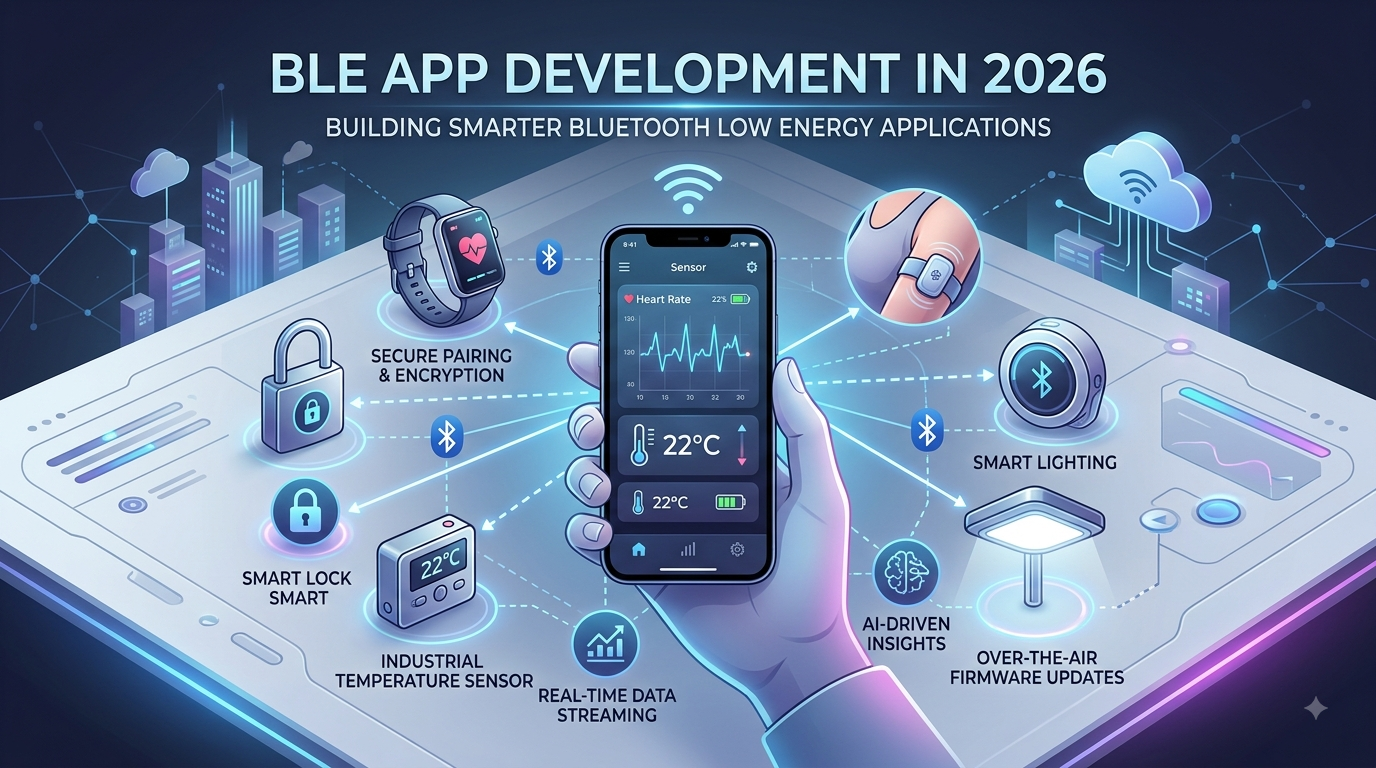
Bluetooth Low Energy (BLE) has evolved from a simple power-saving connectivity standard into the critical backbone of the modern IoT ecosystem. In 2026, BLE app development is moving beyond basic device pairing toward intelligent, secure, and highly connected systems.
BLE’s unique low-power requirements make it indispensable for the explosion of battery-powered devices, including fitness trackers, critical healthcare sensors, smart home automation, and advanced industrial monitors. Modern mobile platforms now provide robust, built-in BLE support for seamless device discovery, service access, and complex data exchange.
For businesses developing connected products, a well-designed BLE application is no longer optional—it is the essential bridge that transforms physical hardware into intelligent digital experiences.
What Is BLE App Development?
BLE app development is the specialized process of creating mobile or software applications that communicate with Bluetooth Low Energy-enabled hardware. A standard BLE application must reliably execute a complex range of functions:
- Discover: Efficiently scan for and identify specific nearby devices.
- Connect: Establish and manage robust connections (and handle disconnects gracefully).
- Read & Write: Access device information, send configuration commands, and exchange sensor data.
- Monitor & Notify: Provide real-time status updates and notifications from the hardware.
- Synchronize: Act as a gateway to sync local device data with cloud platforms.
Unlike traditional Bluetooth (Classic), BLE solutions are radically optimized for low-power, burst-mode communication, making them perfect for devices that must run for months or years on a single coin-cell battery.
Why BLE App Development Matters in 2026: The Intelligence Imperative
The “Low Energy” aspect remains vital, but the headline in 2026 is intelligence. BLE is now the communication layer for AI-enabled edge devices in healthcare, smart factories, logistics, and automotive sectors.
The technology is essential when businesses need reliable, short-range communication without depleting the battery of the critical connected hardware. Furthermore, industry developments like Bluetooth Channel Sounding are revolutionizing spatial awareness, providing high-accuracy distance measurements between connected devices. This opens doors for advanced proximity and security applications that were previously impossible.
Key Features of a Modern (2026-Era) BLE Application
A “good” BLE app in 2026 must do more than just connect. It must handle complex data flows, ensure ironclad security, and integrate intelligence.
1. Advanced Device Discovery and Pairing
The onboarding experience is critical. Modern BLE apps must scan efficiently, identify the correct device based on advertising data, and establish a reliable pairing bond quickly. Users in 2026 expect instant, frustration-free setup.
2. Intelligent, Real-Time Data Communication
BLE applications process high-velocity streams of information:
- Critical health metrics (heart-rate, blood oxygen, glucose levels)
- Environmental data (temperature, humidity, pressure)
- Inertial and motion data for activity tracking or machinery analysis
- Continuous equipment and battery status
A sophisticated app must manage this data throughput efficiently to support real-time monitoring and automated responses.
3. Security: No Longer Optional, Built-In by Design
Security must be a foundation, not an afterthought. Depending on the use case, robust BLE apps must implement a multi-layered approach:
- Secure Pairing & Bonding
- Hardware-Level Authentication
- End-to-End Encryption (as Android documentation correctly emphasizes, sensitive data requires application-layer security to complement native BLE encryption).
- Secure API access to backend services.
4. Flawless Background Connectivity
Many products (like medical monitors or security locks) must function flawlessly in the background. Mastering this is one of the biggest challenges in BLE development. It requires intricate handling of:
- Background execution and wake-up events
- Persistent connection state management
- Operating System (iOS/Android) battery restrictions
5. Seamless Firmware Over-The-Air (FOTA) Updates
Connected products need to get smarter over time or patch security vulnerabilities. A professional BLE app must support secure FOTA updates, allowing manufacturers to improve device functionality remotely without hardware recalls.
Dominant Use Cases for BLE & AI Integration
The fusion of BLE connectivity and artificial intelligence is reshaping multiple industries.
Healthcare and Remote Patient Monitoring
BLE is the lifeline for low-power health devices. Applications support critical remote patient monitoring (RPM), complex fitness tracking, and specialized wearable medical equipment. However, developers must navigate a matrix of regulatory (e.g., FDA, MDR), privacy (e.g., HIPAA), and absolute reliability requirements.
Smart Home & Proximity
BLE apps provide the user interface for everything from smart locks and lighting to security systems and appliances. Proximity-based features, powered by advanced ranging, enable true “walk-up-and-unlock” convenience.
Industrial IoT (IIoT) & Predictive Maintenance
This is where AI shines. Industrial sensors monitor critical equipment, using BLE Mesh to cover large areas. By applying AI algorithms (either on the app/gateway or the cloud), businesses can move from schedule-based maintenance to predictive maintenance, identifying anomalies and usage patterns before failure occurs. BLE also enhances asset tracking and worker safety protocols.
Retail & Automotive
Retailers use BLE beacons for precise indoor navigation and personalized, location-aware engagement. In automotive, BLE facilitates passive entry (digital keys), personalized cabin settings, and vehicle diagnostics.
Cross-Platform Challenges: iOS vs. Android BLE
Achieving a consistent user experience requires navigating the unique quirks of each mobile platform.
iOS BLE Development (Core Bluetooth)
Apple’s Core Bluetooth framework is powerful but rigid. Developers must manage strict rules for permissions, background states, service discovery, and central/peripheral roles.
Android BLE Development
The Android BLE API is highly capable but struggles with fragmentation. Developers must account for varying hardware implementations across manufacturers, diverse OS versions, differing permission models (especially since Android 12/13+), and aggressive background restrictions.
How AIAppDeveloper Transforms BLE Data into Intelligence
BLE is only the beginning. The architecture must connect the physical device to a smarter system.
BLE Device → Mobile App (Data Processor/Gateway) → AI/Cloud Platform → Database & Analytics
This “Connected Intelligence” architecture is the key. Cloud integration enables centralized management, remote monitoring, and powerful data storage. But the final, most crucial step is AI-Driven Insights.
Instead of just displaying raw sensor data, AIAppDeveloper builds smarter systems that analyze that information:
- Predictive Maintenance: Analyzing industrial sensor data to forecast equipment failure.
- AI-Personalized Recommendations: Interpreting fitness tracker data to optimize health plans.
- Anomaly Detection: Instantly identifying dangerous health readings or security breaches.
- Behavioral Automation: Predicting how a user interacts with a device to automate its behavior.
Overcoming BLE App Development Challenges
Building reliable, production-ready BLE solutions is exceptionally complex. Key challenges include:
- Hardware Inconsistency: Managing differences in how hardware manufacturers implement BLE specifications.
- Environmental Reliability: Addressing signal loss and interference in complex real-world environments.
- Complex Power Optimization: Balancing aggressive scanning and connection strategies with optimal battery life.
- Security Vulnerabilities: Protecting sensitive data against sophisticated threats.
A successful BLE product requires an app that is designed, built, and rigorously tested as part of a complete ecosystem—seamlessly integrating hardware, mobile platforms, cloud services, and AI.