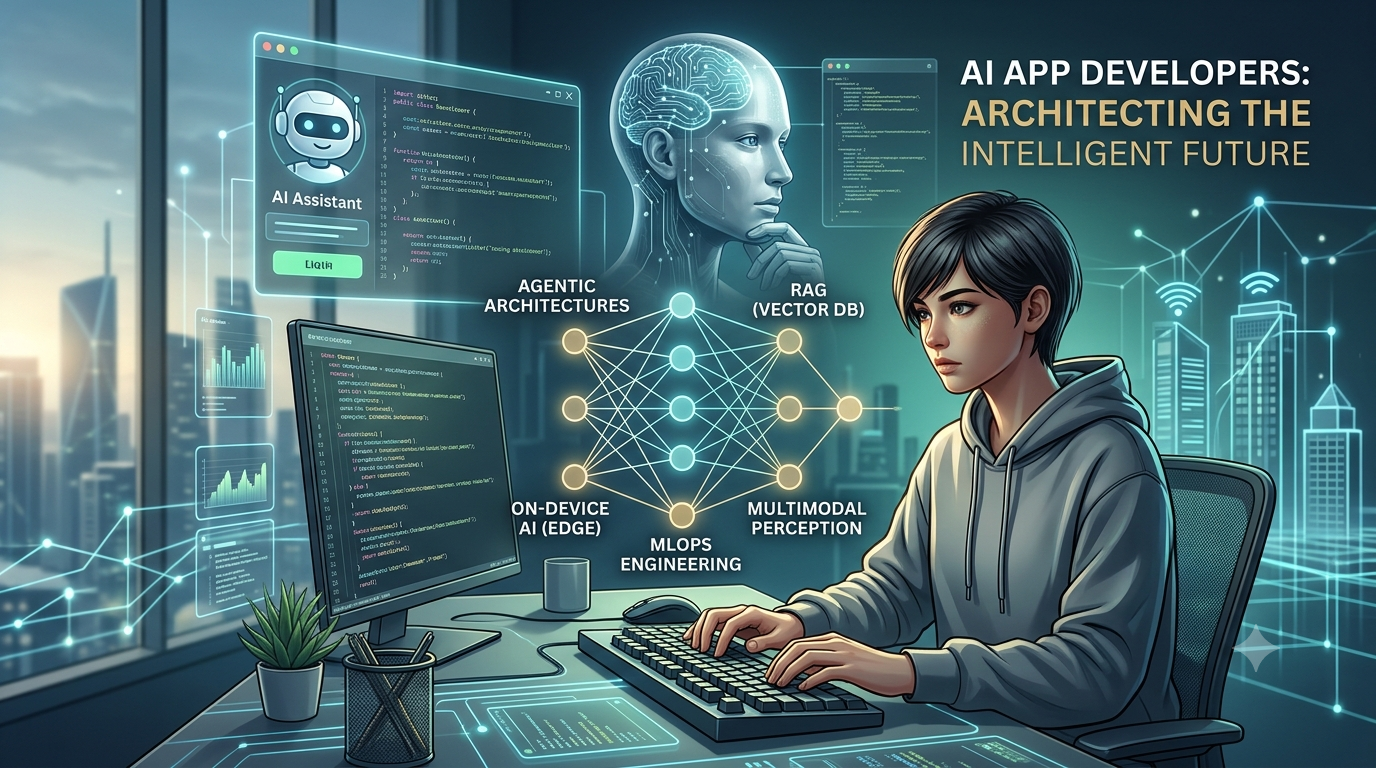
Artificial intelligence is no longer an isolated microservice or a simple chatbot widget tacked onto a user interface. Today, AI serves as the core infrastructure driving intelligent software platforms. Modern AI app developers build dynamic, context-aware systems capable of autonomous reasoning, real-time perception, and continuous learning.
Engineering applications in this paradigm requires moving beyond basic API integration into complex agentic architectures, local edge execution, and robust MLOps engineering.
What Defines a Modern AI App Developer?
An AI app developer specializes in combining traditional software engineering with machine learning operations (MLOps). Rather than building deterministic software where every path is hardcoded, they design probabilistic systems that evaluate context, infer intent, and execute tasks autonomously.
Core Responsibilities
- Agentic Architecture Design: Implementing autonomous workflows using frameworks like LangChain, LlamaIndex, or AutoGen so AI systems can plan, use tools, and self-correct.
- RAG & Knowledge Integration: Constructing Retrieval-Augmented Generation (RAG) pipelines paired with vector databases (e.g., Pinecone, Milvus, Qdrant) to connect Large Language Models (LLMs) with enterprise data.
- Edge & On-Device Optimization: Utilizing model quantization, pruning, and frameworks like Apple CoreML or ONNX Runtime to execute models locally on mobile and IoT devices.
- AI Security & Guardrails: Establishing deterministic fallbacks, prompt injection defenses, and hallucination monitoring to keep outputs reliable and compliant.
Key Shifts Shaping AI App Development
  Traditional App Development                AI-First App Development
┌─────────────────────────────┐            ┌─────────────────────────────┐
│ • Static logic & workflows  │            │ • Dynamic agentic workflows │
│ • Manual feature shipping   │    ───►    │ • Continuous learning loops │
│ • Cloud-only execution      │            │ • Hybrid Edge + Cloud AI    │
│ • Deterministic outputs     │            │ • Probabilistic reasoning   │
└─────────────────────────────┘            └─────────────────────────────┘
1. From Simple Chatbots to Autonomous Agentic AI
Applications are shifting from reactive query-and-response interfaces to agentic workflows. Autonomous agents act as team members inside applications—orchestrating multi-step API calls, resolving customer issues, and executing complex data analysis without constant human prompting.
2. On-Device (Edge) AI Processing
Running models entirely in the cloud can introduce latency, high compute costs, and privacy concerns. Modern developers leverage quantized, small language models (SLMs) running directly on smartphones and laptops. On-device execution yields near-zero latency, offline capability, and inherent data privacy.
3. Multimodal Perception
Text-only interactions are fading. Modern AI apps process text, audio, images, real-time video, and structured sensor streams in a single unified pipeline. This enables richer experiences—ranging from AR diagnostic applications to real-time voice-driven user interfaces.
Essential Tech Stack for AI Application Engineers
| Layer | Tools & Frameworks |
|---|---|
| Orchestration & Agents | LangChain, LlamaIndex, CrewAI, AutoGen |
| Vector Databases | Pinecone, Qdrant, Weaviate, Milvus, pgvector |
| Local / Edge Runtimes | Ollama, ONNX Runtime, GGML/GGUF, Apple CoreML |
| Evaluation & MLOps | LangSmith, Phoenix, Arize, MLflow |
| Model APIs | OpenAI, Anthropic, Google Gemini, Hugging Face Open-Source Models |
Best Practices for Building Reliable AI Applications
- Implement Deterministic Fallbacks: If an AI model’s confidence drops below a designated threshold or Encounters an edge case, the app must gracefully revert to traditional code logic or human review.
- Prioritize Privacy-by-Design: Keep sensitive user data on-device or apply strict anonymization protocols before sending data to external model endpoints.
- Continuous Prompt & Regression Testing: Maintain comprehensive test suites to ensure model updates or system prompt tweaks do not introduce logic regressions or unexpected hallucinations.
- Build Audit-Ready Logging: Store detailed logs of model inputs, output confidence scores, and tool choices to simplify debugging, compliance, and post-launch auditing.
Final Thoughts
The role of the AI app developer has expanded beyond traditional front-end and back-end integration. By mastering agentic workflows, on-device model optimization, and robust evaluation systems, developers can build scalable, context-aware software that delivers true user impact.