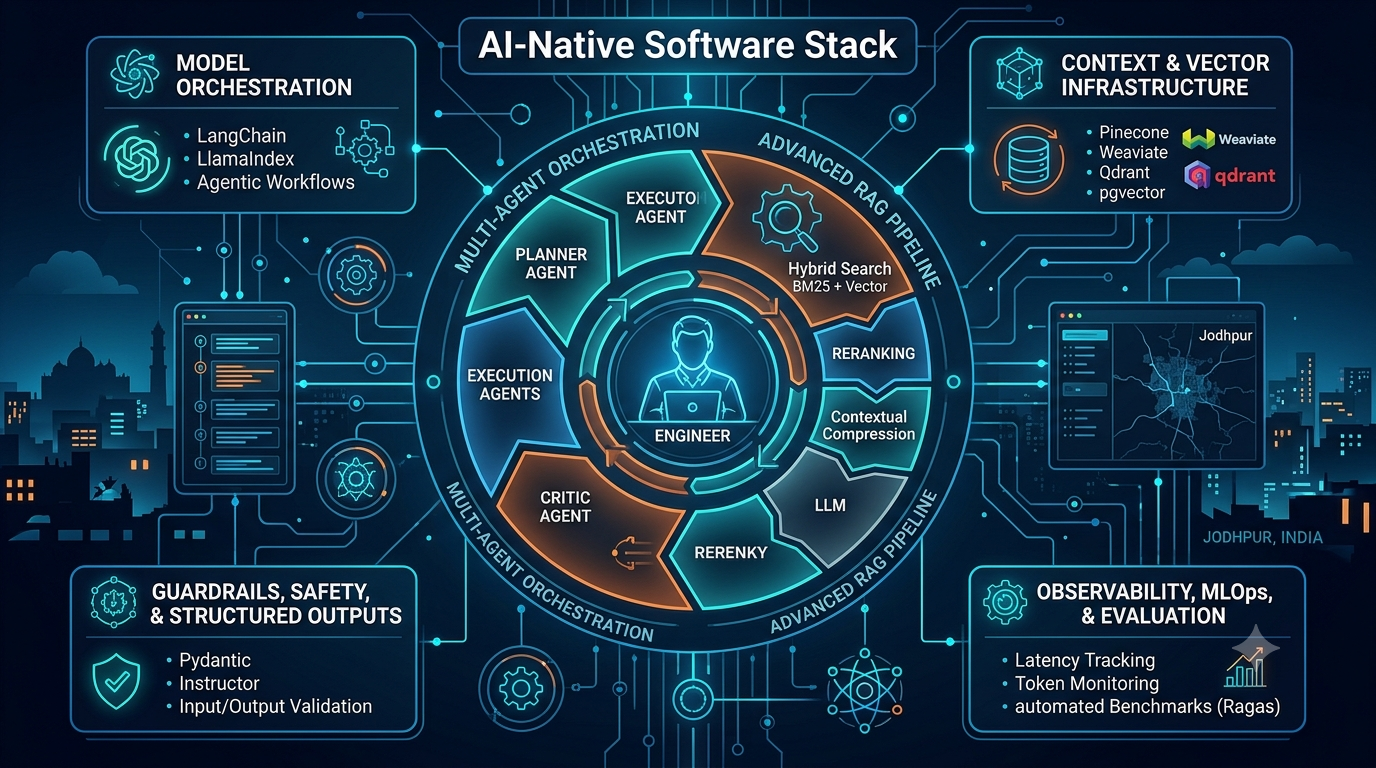
The role of the application engineer has fundamentally shifted. Software development is no longer just about writing business logic and wiring CRUD APIs; modern applications are expected to reason, adapt, and act autonomously.
For the modern AI App Developer (aiappdeveloper), building production-grade solutions requires mastering model orchestration, Retrieval-Augmented Generation (RAG), autonomous multi-agent patterns, and low-latency inference pipelines.
The AI-Native Technology Stack
To deliver fast, secure, and context-aware applications, developers must move beyond basic API wrappers and adopt an AI-native architecture.
| Architectural Layer | Recommended Technology / Tools | Primary Engineering Purpose |
| Model Orchestration | LangChain, LlamaIndex, Semantic Kernel | Managing prompt templates, chains, and multi-modal tool execution. |
| Vector Infrastructure | Pinecone, Weaviate, Qdrant, pgvector | High-dimensional embeddings storage for hybrid semantic search. |
| Context & Retrieval | Advanced RAG, Hybrid Search (BM25 + Dense) | Grounding LLM responses in real-time enterprise knowledge. |
| Agentic Frameworks | AutoGen, CrewAI, LangGraph | Orchestrating autonomous, multi-agent goal solving and tool usage. |
| Observability & Guardrails | LangSmith, Arize, NeMo Guardrails | Monitoring latency, cost, token usage, and preventing prompt injection. |
Essential Architectural Patterns for AI Application Engineering
1. Advanced Retrieval-Augmented Generation (RAG)
Passing an entire enterprise database into a context window is cost-prohibitive and leads to high latency. AI app developers rely on advanced RAG pipelines:
- Hybrid Search: Combining keyword-based BM25 search with dense vector embeddings to maximize retrieval accuracy.
- Reranking Models: Applying specialized cross-encoder models (e.g., Cohere Rerank) to filter and rank retrieved contexts before passing them to the LLM.
- Contextual Compression: Trimming retrieved documents down to only the relevant tokens to lower costs and reduce response times.
2. Autonomous Multi-Agent Orchestration
Single-prompt interactions are giving way to collaborative multi-agent loops. Instead of relying on one massive prompt, complex tasks are broken down across specialized AI agents:
- Planner Agent: Deconstructs user requests into structured sequential tasks.
- Execution Agents: Specialized micro-agents that query vector databases, call external REST APIs, or execute code in isolated sandboxes.
- Critic/Validator Agent: Evaluates execution outputs against safety criteria and JSON schema constraints before returning the result to the user.
┌─────────────────────────────────────────────────────────────┐
│                 MULTI-AGENT ORCHESTRATION                   │
├─────────────────────────────────────────────────────────────┤
│ User Request ──> [ Planner Agent ]                          │
│                         │                                   │
│                         ├──> [ RAG Retrieval Agent ]        │
│                         ├──> [ API Execution Agent ]        │
│                         │                                   │
│                         ▼                                   │
│                  [ Critic Agent ] ──> Validated Output      │
└─────────────────────────────────────────────────────────────┘
3. Guardrails, Safety, and Structured Outputs
Production AI applications must be predictable. Developers use strict type enforcement—such as Pydantic, Instructor, or native JSON modes—to force models to return structured payloads for frontend rendering. Additionally, input/output validation layers prevent prompt injection, system prompt leakage, and data exfiltration.
Key Enterprise Engineering Priorities
Latency Optimization & Streaming
User experience drops sharply when interfaces stall during LLM generation. AI app developers prioritize Server-Sent Events (SSE) and WebSocket streaming to display initial tokens instantly. For resource-intensive workloads, speculative decoding and local model caching reduce latency across frequent user pathways.
Continuous MLOps & Evaluation Pipelines
Building the app is only step one; maintaining quality requires continuous evaluation. Production pipelines capture user feedback loops (thumbs up/down, edit rates) and run automated evaluation benchmarks (e.g., Ragas, TruLens) to detect model drift and hallucination spikes.
Bridging the Gap Between Models and Production
Being a successful AI app developer is not about relying solely on external APIs; it is about building resilient, scalable systems around those models. By combining robust RAG architectures, structured outputs, strict security guardrails, and agentic workflows, software engineers build intelligent applications that deliver real business value.