Introduction
Artificial intelligence is changing how businesses develop software, serve customers, manage information, and automate everyday operations.
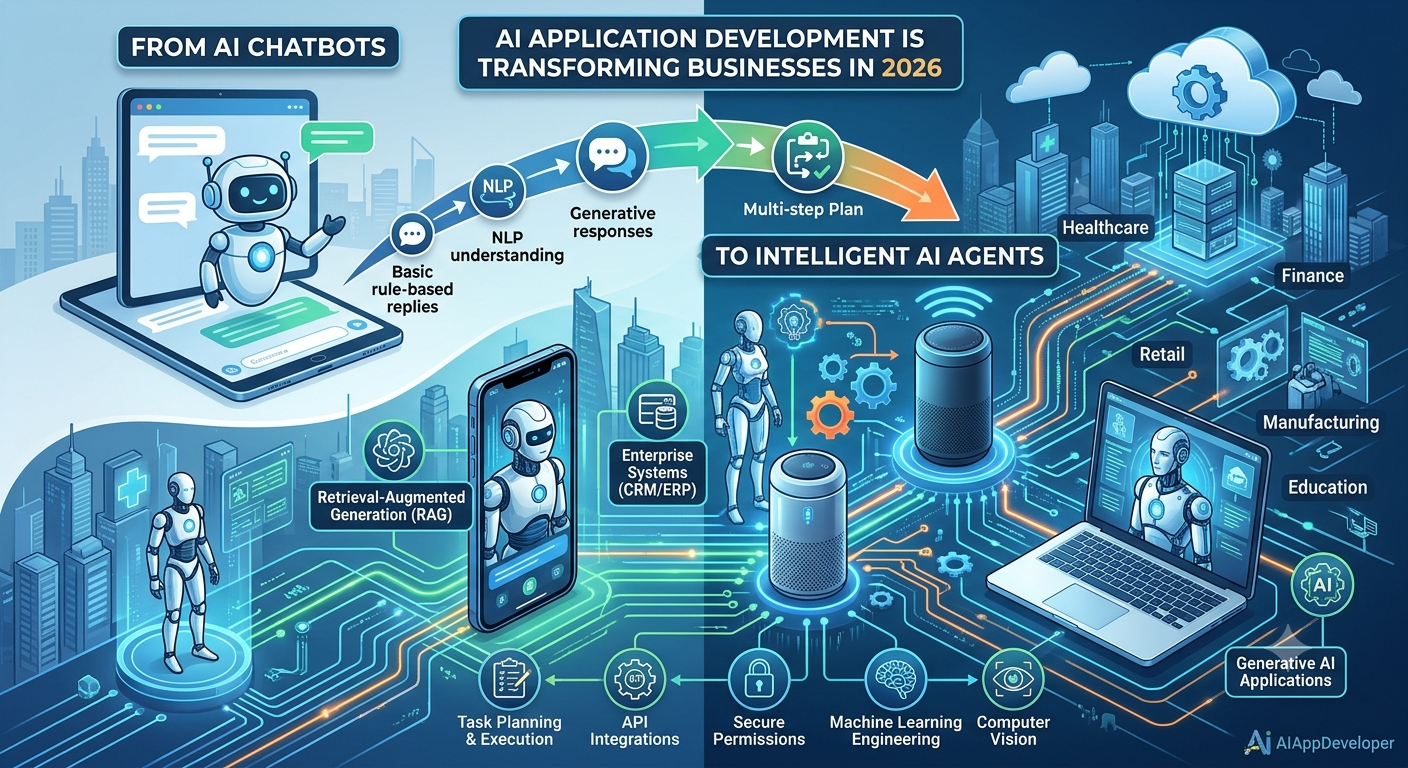
A few years ago, AI-powered applications were primarily associated with chatbots, recommendation engines, and automated customer support. Today, businesses are exploring more advanced applications that can understand requests, analyze information, coordinate tasks, and execute defined workflows.
This evolution is bringing AI agents, generative AI, machine learning, and intelligent automation into modern application development.
In 2026, companies are increasingly looking beyond basic AI features. They want applications that solve practical business problems, integrate with existing software, protect sensitive information, and deliver measurable value.
For organizations planning their next digital product, understanding this shift is essential.
Let’s explore how AI application development is evolving and what businesses should consider when building intelligent software solutions.
1. The Evolution of AI Application Development
Traditional applications follow predefined instructions. Users enter information, select options, and receive outputs based on programmed rules.
AI-powered applications introduce additional capabilities. Depending on their design, they can interpret natural language, recognize patterns, generate content, summarize information, and make predictions.
Modern AI applications may combine several technologies:
- Machine Learning: Identifies patterns and generates predictions from data.
- Natural Language Processing: Helps applications understand and process human language.
- Generative AI: Produces text, images, code, and other content.
- Large Language Models: Support conversational experiences, reasoning, and information processing.
- Computer Vision: Analyzes images and video.
- AI Agents: Perform defined tasks by interacting with tools, APIs, and business systems.
The most important change is that AI is becoming part of the application’s core functionality rather than simply an additional feature.
Businesses can now explore software experiences that respond more naturally to users and automate complex workflows.
2. AI Agents Are Changing How Business Applications Work
One of the major developments in AI application development is the growth of agent-based systems.
A traditional chatbot usually responds to user questions. An AI agent can go further by planning and carrying out a sequence of permitted actions using connected tools.
For example, consider an AI-powered customer support application.
A basic chatbot might answer questions about an order. An AI agent could potentially:
- Understand the customer’s request.
- Retrieve order information through an authorized API.
- Check the delivery status.
- Identify whether an issue needs escalation.
- Prepare an appropriate response.
- Request human approval before performing a sensitive action.
This creates opportunities for businesses to automate workflows that previously required multiple manual steps.
Business Applications of AI Agents
- Customer service automation
- Sales lead qualification
- Appointment scheduling
- Document processing
- Internal knowledge management
- IT support workflows
- Financial reporting assistance
- Inventory and operations coordination
However, AI agents should operate within clearly defined permissions. Businesses need human oversight, action limits, audit logs, and safeguards for important decisions.
3. Generative AI Is Creating New Possibilities for Custom Applications
Generative AI has expanded what businesses can build into their digital products.
Instead of relying exclusively on fixed templates and predefined interactions, applications can generate context-aware responses and content based on user input.
Some practical examples include:
AI-Powered Content Applications
Businesses can develop applications that help users generate product descriptions, marketing content, reports, and summaries.
Intelligent Document Processing
AI applications can extract information from invoices, contracts, forms, and other business documents.
Personalized Learning Platforms
Educational applications can provide explanations, learning recommendations, and interactive exercises based on individual progress.
AI-Powered Search
Businesses can build intelligent search experiences that understand the meaning and context of user questions rather than relying only on exact keyword matches.
Automated Business Reporting
AI can help users summarize business information, identify trends, and generate reports from connected data sources.
The value of generative AI depends on the quality of the underlying information, the application’s design, and how effectively the technology is integrated into real workflows.
4. Five Industries Benefiting from AI Application Development
AI applications are becoming relevant across industries because many business operations involve large amounts of information, repetitive tasks, and complex decisions.
A. Healthcare
Healthcare organizations can explore AI applications for administrative workflows, medical document processing, appointment management, and patient communication.
Potential solutions include:
- AI-powered appointment assistants
- Medical document summarization
- Healthcare administrative automation
- Patient engagement applications
- Clinical information search tools
Healthcare AI requires particular attention to privacy, accuracy, clinical validation, and applicable regulations. AI-generated information should not replace qualified medical judgment.
B. Finance and Banking
Financial institutions handle large volumes of transactions, customer information, and operational data.
AI-powered applications can support:
- Fraud detection
- Transaction monitoring
- Customer support automation
- Document verification
- Financial data analysis
- Risk assessment assistance
Sensitive financial decisions should include appropriate validation, security controls, and human review.
C. Retail and E-Commerce
Retail businesses can use AI applications to create more personalized customer experiences and improve operational efficiency.
Examples include:
- AI shopping assistants
- Product recommendation systems
- Intelligent inventory forecasting
- Automated customer support
- Visual product search
- Customer sentiment analysis
These applications can help businesses connect customer information with relevant product and service experiences.
D. Manufacturing
Manufacturers can use AI-powered software to analyze equipment data, monitor production processes, and support maintenance planning.
Common applications include:
- Predictive maintenance
- Visual quality inspection
- Production analytics
- Equipment monitoring
- Supply chain forecasting
- Manufacturing workflow automation
AI systems need reliable data and proper integration with operational technology to produce useful results.
E. Education
Educational institutions and learning platforms can use AI to create more interactive and personalized experiences.
Examples include:
- AI learning assistants
- Automated content recommendations
- Intelligent assessment support
- Student engagement analytics
- Personalized learning paths
- Educational content generation
Responsible implementation is important, especially when applications involve student information or automated assessments.
5. AI-Powered Mobile App Development Is Becoming More Intelligent
Mobile applications are also evolving as AI capabilities become easier to integrate into software products.
Businesses are exploring AI features that make mobile applications more responsive, personalized, and useful.
Some examples include:
Voice-enabled applications: Users can interact with apps through natural speech.
Image recognition: Applications can identify objects, products, and visual information.
Personalized recommendations: AI can suggest relevant products, services, or content based on user behavior.
AI assistants: Mobile users can access conversational assistance and task automation.
Predictive features: Applications can identify patterns and provide useful recommendations.
Developers must consider whether AI processing should happen on the device, through a cloud-based model, or using a combination of both.
On-device AI may support privacy and offline functionality in suitable cases, while cloud-based processing can provide access to larger models and more computational resources.
6. Important Technologies Behind Modern AI Applications
Building a reliable AI application requires selecting the right combination of technologies.
Large Language Models
LLMs support natural language understanding, conversational interfaces, content generation, and other language-based features.
Retrieval-Augmented Generation (RAG)
RAG connects AI models with external information sources so applications can retrieve relevant business documents and provide responses grounded in available information.
It is particularly useful for enterprise knowledge assistants and document-based applications.
Machine Learning Frameworks
Frameworks such as TensorFlow and PyTorch help developers build, train, and deploy machine learning models.
AI APIs and Model Integration
AI APIs allow applications to connect with external models and services without developing every AI capability from scratch.
Vector Databases
Vector databases help applications store and retrieve information based on semantic similarity. They are commonly used in RAG and intelligent search systems.
Cloud and Edge Computing
Cloud infrastructure supports scalable AI workloads, while edge computing enables selected processing closer to the device or data source.
The right technology stack depends on application requirements, data sensitivity, latency, operating costs, and scalability.
7. Security and Privacy: Essential Requirements for AI App Development
AI applications often interact with customer information, business documents, internal databases, and external services.
This creates security and privacy considerations that developers must address from the beginning.
Important practices include:
- Encrypting sensitive information in transit and at rest
- Applying role-based access controls
- Protecting API credentials and application secrets
- Validating user input and model outputs
- Preventing unauthorized access to connected tools
- Monitoring application activity
- Maintaining audit logs
- Establishing data retention and deletion policies
- Testing for prompt injection and other AI-specific risks
For AI agents, tool permissions should be especially restrictive. An agent that can read information does not necessarily need permission to modify records, issue refunds, or transfer funds.
Human approval should be included where actions have financial, legal, operational, or privacy consequences.
Security is not an optional feature of an AI application. It is a fundamental part of product architecture.
8. Challenges Businesses Should Consider Before Building an AI Application
Although AI creates significant opportunities, implementing it successfully requires careful planning.
Data Quality
AI applications depend on relevant and reliable data. Incomplete, outdated, or inconsistent information can lead to inaccurate outputs.
Integration Complexity
Connecting AI models with existing CRM, ERP, payment, inventory, and other enterprise systems can require significant development work.
AI Hallucinations
Generative AI systems can produce incorrect information. Applications should use appropriate validation, retrieval, confidence checks, and human review.
Operating Costs
AI usage can involve model inference, API calls, infrastructure, storage, and monitoring costs.
Businesses should estimate ongoing expenses rather than considering development costs alone.
Performance and Scalability
An AI application must respond reliably as the number of users, requests, and connected systems increases.
Compliance and Governance
Organizations must consider applicable privacy, industry, data protection, and AI governance requirements.
A successful AI application balances innovation with reliability, security, usability, and long-term maintenance.
9. How to Choose the Right AI Application Development Company
Selecting an experienced development partner can make a major difference in the success of an AI project.
Businesses should evaluate potential partners based on their technical expertise and ability to understand real business requirements.
Look for experience in:
- Custom AI application development
- Generative AI integration
- AI agent development
- Machine learning engineering
- Natural language processing
- Mobile and web application development
- API and enterprise software integration
- Cloud infrastructure
- AI security and testing
- Ongoing application maintenance
A development partner should also help determine whether AI is actually the right solution for the problem.
Not every business process needs an AI agent. Sometimes traditional automation, better software integration, or a simpler machine learning model may provide a more reliable and cost-effective result.
10. The Future of AI Application Development
AI application development is moving toward more intelligent, integrated, and task-oriented software.
Several trends are likely to influence upcoming projects:
Agentic AI Applications
Applications will increasingly use agents to coordinate defined tasks across connected systems, with appropriate permissions and oversight.
Multimodal AI
AI applications can combine text, images, audio, and video to support richer user experiences.
AI-Powered Software Engineering
AI tools are increasingly supporting coding, testing, documentation, and other software development activities.
Domain-Specific AI Models
Businesses may adopt models tailored to particular industries, workflows, or specialized information requirements.
AI Governance and Observability
Organizations will need better tools to monitor model performance, control permissions, evaluate outputs, and manage operational risks.
Human-AI Collaboration
Rather than removing people from every process, many applications will combine AI automation with human expertise and approval.
The strongest AI applications will not simply use the newest models. They will solve specific problems, integrate with business systems, and deliver outcomes that can be measured.
Frequently Asked Questions (FAQs)
1. What is AI application development?
AI application development is the process of creating software that uses artificial intelligence technologies such as machine learning, natural language processing, computer vision, and generative AI to perform intelligent tasks.
2. What is the difference between AI app development and traditional app development?
Traditional applications mainly follow predefined programming rules. AI-powered applications can also analyze information, recognize patterns, generate content, and provide context-aware responses.
3. What is an AI agent?
An AI agent is a software system that can interpret a goal, plan tasks, and use connected tools or services to complete defined actions within its permissions.
4. What is generative AI in application development?
Generative AI allows applications to create content such as text, images, summaries, and code based on user instructions and contextual information.
5. What is RAG in AI application development?
Retrieval-Augmented Generation connects an AI model with external information sources. It retrieves relevant information before generating a response, helping applications answer questions using specific business or organizational data.
6. How much does custom AI application development cost?
The cost depends on application complexity, model selection, data preparation, integrations, user experience, security requirements, infrastructure, and ongoing maintenance. A detailed project scope is necessary for an accurate estimate.
7. Can AI be integrated into an existing mobile or web application?
Yes. AI capabilities can often be integrated into existing applications through APIs, custom models, cloud services, or on-device AI technologies.
8. Is AI application development secure?
It can be designed securely through encryption, access controls, secure API integration, monitoring, data governance, and appropriate AI-specific safeguards. Security depends on implementation and ongoing maintenance.
9. Which industries benefit from AI application development?
Healthcare, finance, retail, manufacturing, education, logistics, real estate, and professional services are among the industries exploring AI-powered applications.
10. How do I choose an AI app development company?
Evaluate the company’s experience with AI technologies, software engineering, data integration, security, deployment, scalability, and ongoing support. Also look for a clear understanding of your business objectives.
Conclusion
AI application development is entering a new phase in 2026. Businesses are moving beyond basic chatbots and experimenting with intelligent applications that can understand information, automate workflows, and interact with connected software systems.
Generative AI, machine learning, RAG, and AI agents are creating new opportunities across industries. However, successful implementation requires more than selecting an AI model.
Data quality, security, integration, cost management, and human oversight are equally important.
For organizations planning their next digital product, the goal should be to build AI applications that solve genuine business challenges and provide long-term value.
AIAppDeveloper explores AI technologies, intelligent software solutions, and modern application development approaches helping businesses turn innovative ideas into practical digital products.