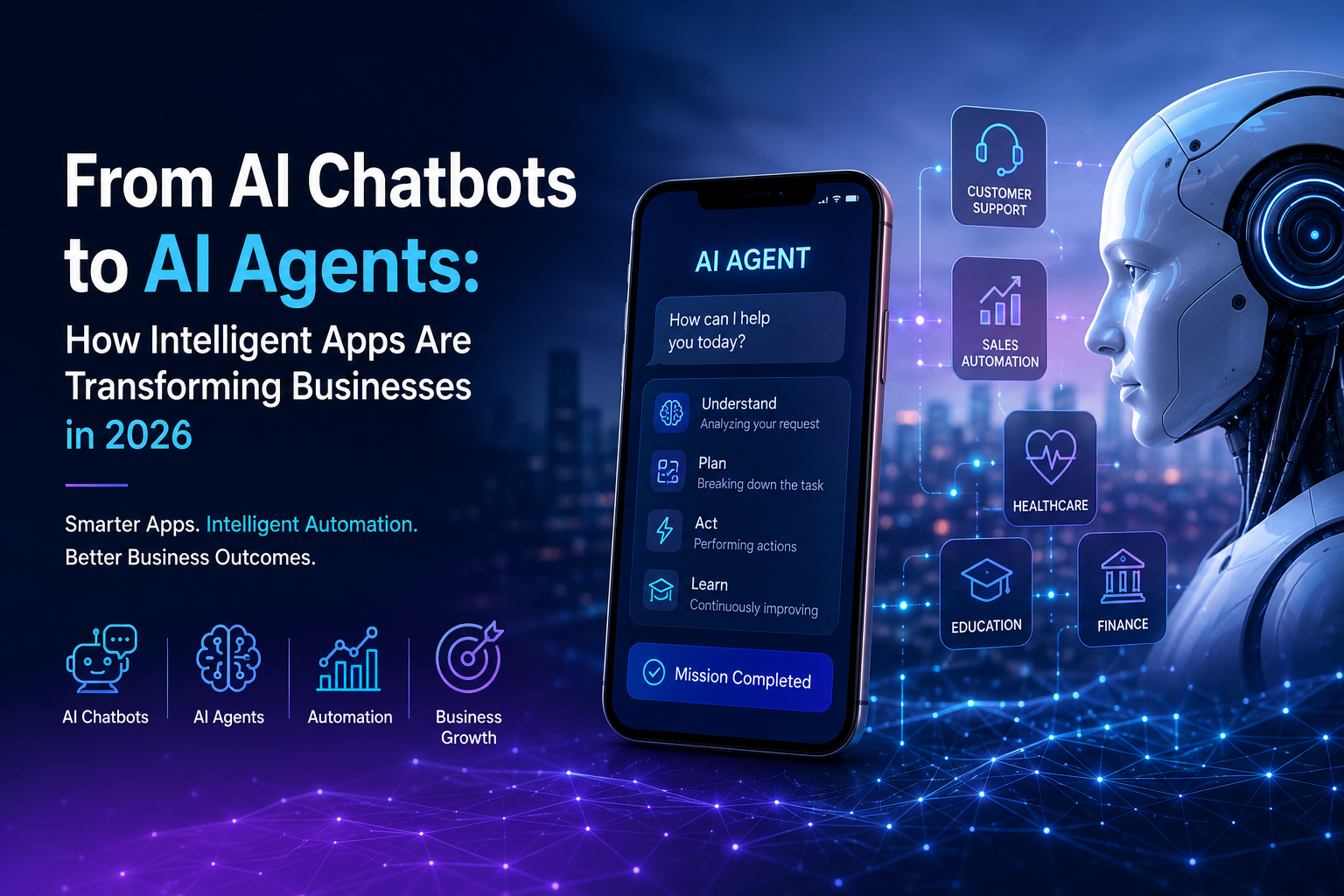
Artificial intelligence is no longer limited to answering customer questions or generating content. In 2026, businesses are moving beyond basic AI chatbots and exploring intelligent AI applications that can understand goals, analyze information, make recommendations, and complete multi-step tasks.
This evolution is changing how companies approach customer service, sales, operations, healthcare, finance, education, and software development.
The next generation of AI-powered applications is not designed only to respond. It is designed to assist, automate, adapt, and help businesses achieve measurable outcomes.
What Is the Difference Between an AI Chatbot and an AI Agent?
An AI chatbot is primarily designed to communicate with users. It receives a question, processes the request, and generates a response.
An AI agent can go further.
AI agents can be designed to:
- Understand a business goal
- Break a complex task into smaller steps
- Access connected tools and business systems
- Analyze data
- Make context-aware recommendations
- Perform approved actions
- Report results to users or teams
For example, a traditional customer support chatbot may answer:
“What is the status of my order?”
An AI-powered customer service agent could potentially:
- Identify the customer
- Check the order management system
- Review shipping information
- Detect a delivery issue
- Create a support ticket
- Send an updated delivery notification
This creates a more useful and connected customer experience.
Why Businesses Are Investing in AI-Powered Applications
Businesses are adopting AI applications because customers and employees expect faster, more personalized, and more intelligent digital experiences.
A well-developed AI application can help organizations:
1. Automate Repetitive Work
Many teams spend valuable time on repetitive activities such as:
- Entering data
- Sorting documents
- Responding to common customer questions
- Creating reports
- Scheduling appointments
- Reviewing large amounts of information
AI automation can reduce manual effort and allow employees to focus on strategic and high-value work.
2. Improve Customer Experiences
AI applications can analyze customer behavior, preferences, previous interactions, and real-time activity.
This can help businesses provide:
- Personalized recommendations
- Faster support
- Relevant product suggestions
- Smart onboarding experiences
- More accurate responses
Personalization is becoming an important part of modern mobile and web applications.
3. Support Faster Decision-Making
Businesses generate large amounts of information every day. AI can help transform raw data into useful insights.
AI-powered dashboards can identify:
- Sales trends
- Customer behavior patterns
- Operational risks
- Unusual activity
- Growth opportunities
Instead of manually reviewing multiple reports, business leaders can receive relevant insights through a single intelligent platform.
4. Create Scalable Digital Products
AI applications can support growing businesses without requiring every process to be handled manually.
For example, an AI-powered learning platform can provide personalized educational content to thousands of users. An intelligent customer support system can help manage a growing number of requests while maintaining consistent service.
Scalability should be considered from the beginning of AI app development.
Popular Types of AI Applications in 2026
AI is being integrated into many types of mobile and web applications.
AI Customer Support Applications
These applications can help customers find information, troubleshoot problems, and receive support at any time.
Common features include:
- AI chat assistants
- Automated ticket routing
- Sentiment analysis
- Multilingual support
- Smart knowledge search
AI Sales Applications
AI can help sales teams identify opportunities and improve customer engagement.
Features may include:
- Lead scoring
- Sales forecasting
- Automated follow-ups
- Personalized outreach
- Customer behavior analysis
AI Healthcare Applications
AI-powered healthcare solutions can support medical professionals and patients through:
- Appointment automation
- Medical document analysis
- Patient engagement
- Health data monitoring
- Intelligent healthcare workflows
AI should support qualified professionals and be developed with strong privacy, security, and compliance practices.
AI Education Applications
AI can make learning more interactive and personalized.
Examples include:
- AI tutors
- Adaptive learning platforms
- Automated assessments
- Personalized study plans
- Intelligent learning recommendations
AI Finance Applications
Financial organizations can use AI for:
- Fraud detection
- Expense analysis
- Financial forecasting
- Customer support
- Risk assessment
Because financial applications process sensitive information, security and responsible AI practices are essential.
Key Features of a Successful AI Application
Adding an AI model to an app is not enough. A successful AI product requires useful features, reliable data, strong architecture, and a clear business purpose.
Important elements include:
Clear Business Objectives
Every AI feature should solve a real problem.
Before development begins, businesses should ask:
- What problem will the AI application solve?
- Who will use it?
- What tasks should AI assist with?
- How will success be measured?
A clear strategy helps prevent unnecessary features and keeps development focused.
High-Quality Data
AI systems depend on the quality of the information they use.
Poor, outdated, incomplete, or inconsistent data can reduce the reliability of AI-generated results.
A strong AI development process should include:
- Data validation
- Data cleaning
- Secure data management
- Regular monitoring
- Performance evaluation
Human Oversight
AI should not operate without appropriate controls in every situation.
Human review is especially important when applications affect:
- Financial decisions
- Healthcare information
- Legal processes
- Security
- Customer accounts
Human-in-the-loop systems can help businesses maintain control while benefiting from AI automation.
Security and Privacy
AI applications may process customer information, business documents, financial data, or confidential records.
Security should be included throughout the development process.
Important practices may include:
- Secure authentication
- Data encryption
- Role-based access
- API security
- Activity monitoring
- Privacy-focused architecture
Scalable Infrastructure
An AI application should be prepared for future growth.
A scalable architecture can help support:
- More users
- Larger datasets
- New AI features
- Additional integrations
- Increased application traffic
Cloud-based infrastructure and modular application architecture can make future expansion easier.
The AI App Development Process
Building an AI application requires more than writing code. It involves strategy, product design, data planning, AI integration, testing, and ongoing improvement.
A typical development process includes:
Step 1: AI Strategy and Discovery
The development team identifies the business problem, target users, required features, technical requirements, and expected outcomes.
Step 2: Product Planning
The team creates the application roadmap and defines:
- User journeys
- AI capabilities
- Integrations
- Data requirements
- Security needs
- Development priorities
Step 3: UI and UX Design
AI applications should remain simple and easy to use.
Users should understand:
- What the AI can do
- How AI-generated results are created
- When human review is required
- How to correct or provide feedback on results
Step 4: AI Model and Technology Selection
The right technology depends on the application.
Possible technologies include:
- Large language models
- Machine learning models
- Natural language processing
- Computer vision
- Speech recognition
- Predictive analytics
- AI agent frameworks
The best solution is not always the largest or most complex model. It is the technology that meets the product’s requirements efficiently and reliably.
Step 5: Application Development
Developers build the mobile application, web platform, backend systems, APIs, databases, and AI integrations.
Step 6: Testing and Validation
AI applications should be tested for:
- Accuracy
- Performance
- Security
- User experience
- Reliability
- Edge cases
- Responsible AI behavior
Step 7: Deployment and Continuous Improvement
After launch, the application should be monitored and improved using user feedback and performance data.
AI products are not always “build once and forget.” They may require ongoing evaluation, optimization, and updates.
How to Choose an AI App Development Company
Choosing the right development partner can affect the success of an AI project.
Consider these factors:
Technical Experience
Look for experience with:
- AI application development
- Machine learning
- Generative AI
- AI agents
- Mobile and web development
- Cloud infrastructure
- API integrations
Business Understanding
A development company should understand the business problem before recommending technology.
The goal should be to create a useful product—not to add AI simply because it is trending.
Custom Development Capabilities
Every business has different requirements.
Custom AI application development can provide greater flexibility for:
- Unique workflows
- Industry-specific features
- Business integrations
- Custom user experiences
- Long-term scalability
Security Practices
Ask how the company handles:
- Data privacy
- Application security
- User access
- AI model integrations
- Sensitive business information
Post-Launch Support
AI applications may require ongoing improvements.
A reliable development partner should be able to support:
- Performance monitoring
- Feature updates
- Security improvements
- AI optimization
- Application maintenance
The Future of AI Applications
The future of AI app development is moving toward intelligent systems that can understand context, work across connected platforms, and support complete business workflows.
Businesses are increasingly exploring AI agents that can coordinate multi-step processes rather than only generating answers. This shift is expected to influence productivity, customer service, software development, security, and business operations.
However, successful AI adoption will depend on more than powerful models.
Businesses will need:
- Reliable data
- Clear use cases
- Secure infrastructure
- Responsible AI practices
- Human oversight
- Skilled development teams
The companies that focus on practical value instead of AI hype will be better positioned to build useful and sustainable AI products.
Build Your Custom AI Application with AIAppDevelopers.ai
At AIAppDevelopers.ai, we help startups, entrepreneurs, and businesses transform ideas into intelligent digital products.
Our AI application development services can support:
- Custom AI applications
- AI-powered mobile apps
- AI web applications
- Generative AI solutions
- AI chatbot development
- AI agent development
- Machine learning solutions
- AI automation platforms
- AI integration and consulting
Whether you are developing a new AI startup, modernizing an existing application, or automating a business workflow, the right strategy and technology can help turn your idea into a scalable solution.
Conclusion
AI applications are evolving from simple digital tools into intelligent business systems.
The biggest opportunity is not simply adding a chatbot to an application. It is creating AI-powered experiences that solve real problems, improve efficiency, support better decisions, and deliver value to users.
With the right AI strategy, secure architecture, reliable data, and experienced development team, businesses can build intelligent applications designed for long-term growth.
Ready to turn your AI idea into a powerful digital product?
Connect with AIAppDevelopers.ai to discuss your custom AI application development project.