Integrating AI into mobile applications has shifted from simple API calls to building resilient, context-aware, AI-first software systems.
Building production-ready AI mobile applications requires navigating complex architectural choices across on-device edge processing, cloud orchestration, vector retrieval, and user experience design.
At AI App Developer, we help organizations transition from experimental AI prototypes to scalable, high-performance mobile ecosystems. Here is an architectural blueprint for developing modern AI-driven mobile apps.
The AI Mobile App Stack Architecture
Unlike traditional client-server apps governed by fixed business rules, an AI mobile application processes non-deterministic inputs, real-time context, and continuously evolving models.
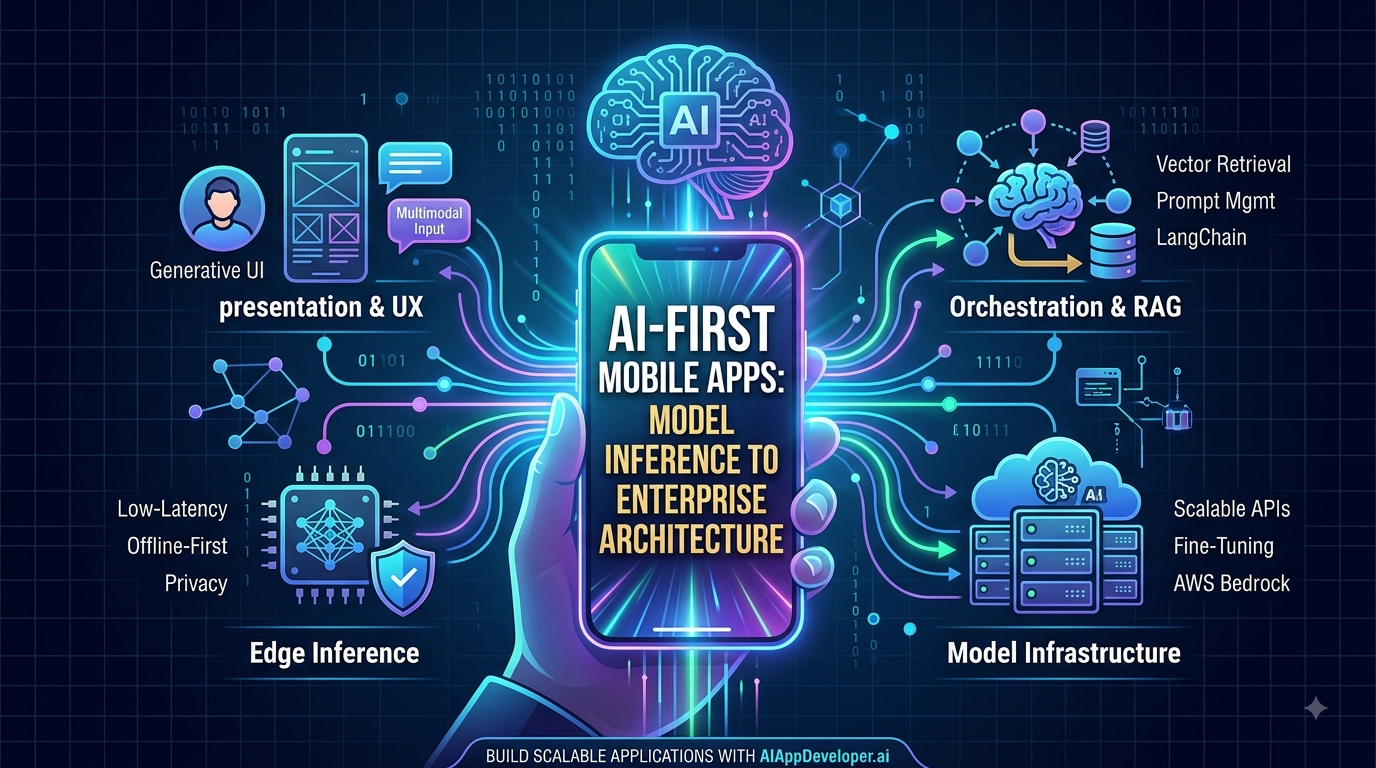
A production AI app ecosystem spans four core layers:
Mobile UX Engine 📱⟷Edge Logic / On-Device ML ⚡⟷RAG & Orchestration 🧠⟷Enterprise Data Infrastructure ☁R◯
Component Breakdown
| Layer | Functionality | Primary Tech / Infrastructure |
|---|---|---|
| Presentation & UX | Generative UI, streaming text responses, multimodal inputs (voice/vision), agent feedback loops. | Swift/SwiftUI, Kotlin/Jetpack Compose, React Native, Flutter |
| Edge Inference | Low-latency, offline-first predictions; local sensor processing; data privacy filtering. | CoreML, TensorFlow Lite, ONNX Runtime, Executors / On-Device LLMs |
| Orchestration & RAG | Dynamic prompt management, vector retrieval (RAG), agentic workflows, function calling. | LangChain, LlamaIndex, Vector DBs (Pinecone, Qdrant), Custom Middleware |
| Model Infrastructure | Scalable inference APIs, model fine-tuning, latency optimizations, fallback routing. | OpenAI, AWS Bedrock, Google Vertex AI, vLLM / Hosted Open-Source Models |
Critical Engineering Decisions in AI App Development
1. Hybrid Inference: Edge vs. Cloud
Determining where machine learning execution occurs impacts latency, operational costs, user privacy, and battery efficiency:
- On-Device (Edge ML): Ideal for real-time task processing (e.g., audio/vision processing, text autocompletion). Edge execution eliminates network latency, supports offline use, and keeps sensitive user data localized on the smartphone.
- Cloud-Based ML: Required for complex reasoning tasks, heavy Generative AI models, or massive Retrieval-Augmented Generation (RAG) datasets.
Best practice: Architect a hybrid execution fallback path. Run low-latency classification or preprocessing on-device, then offload heavy reasoning tasks to cloud endpoints.
2. Context Management & Vector Search (RAG)
To make AI applications contextual without incurring massive prompt costs, mobile apps rely on Retrieval-Augmented Generation (RAG).
- Local Caching: Store conversation histories and user state vector embeddings locally (e.g., via SQLite / Local Vector DBs).
- Remote Retrieval: Query cloud vector databases for domain-specific context before sending final prompts to the inference endpoint.
3. Graceful Failure & Non-Deterministic Handling
Generative models can hallucinate or exceed rate limits. Resilient mobile architectures must implement:
- Streaming Responses: Use WebSockets or Server-Sent Events (SSE) to stream output tokens instantly, reducing perceived latency.
- Fallback Mechanisms: Route traffic to lighter models or deterministic rules if primary endpoints experience downtime or latency spikes.
- Confidence Thresholds: Include human-in-the-loop validation steps whenever output confidence drops below acceptable risk levels.
Key Business Capabilities Driven by Mobile AI
Integrating machine learning enables applications to go beyond static software utilities:
- Predictive Workflows: Anticipating user actions, auto-filling operational data, and reducing user drop-off.
- Conversational Interfaces: Replacing rigid navigation hierarchies with dynamic, natural language interfaces.
- Multimodal Intelligence: Combining camera, voice, and location telemetry to solve complex real-world tasks instantly.
- Adaptive Personalization: Continuously tuning content recommendation engines and interface layouts based on user interaction patterns.
Build Scalable AI Mobile Apps with AI App Developer
Developing enterprise-ready AI mobile applications requires deep knowledge across mobile operating system internals, scalable model orchestration, vector retrieval, and UX design.
At AI App Developer, we bring together specialized mobile engineering and modern AI development practices to deliver robust, high-performance applications tailored to your business needs.
👉 Ready to transform your software strategy with custom AI mobile development? Schedule a technical consultation with our engineering team at aiappdeveloper.ai today.