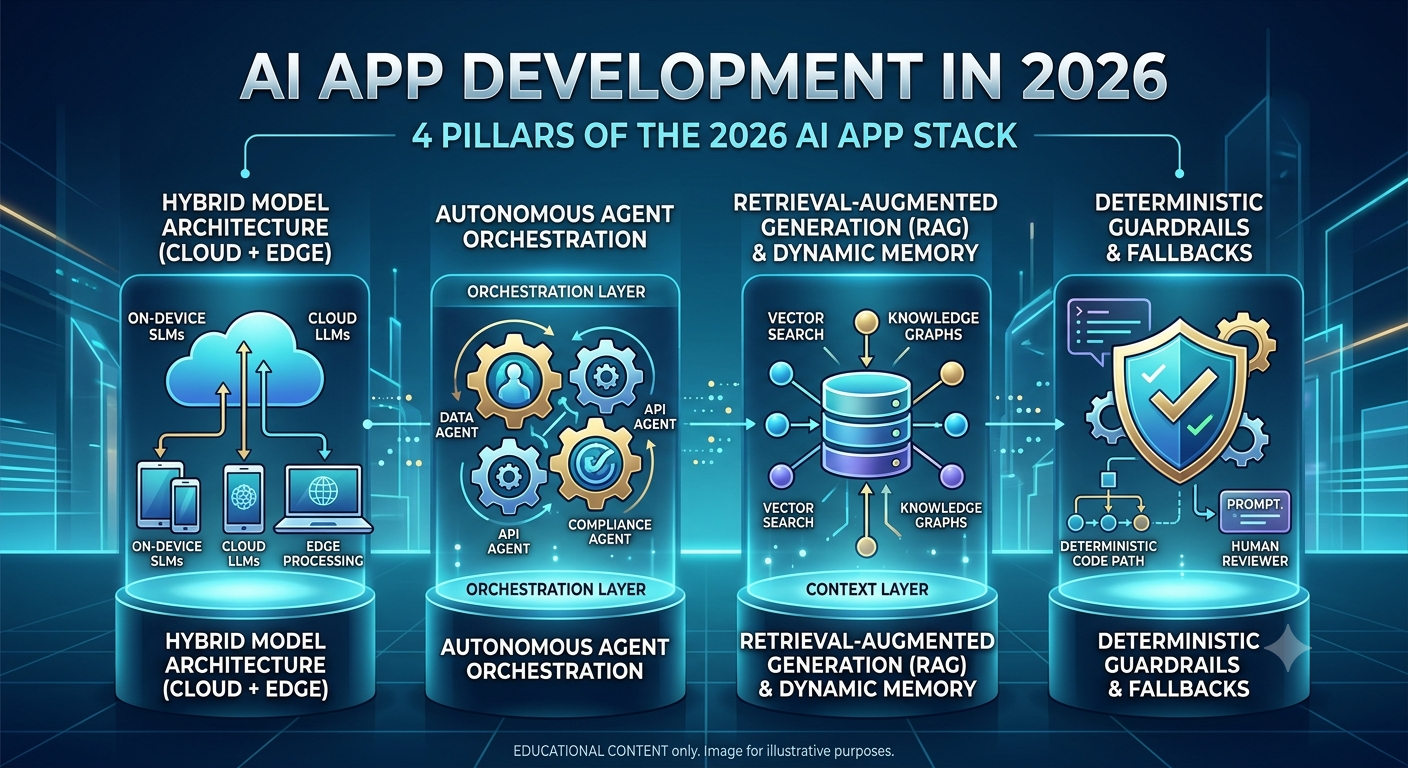
Artificial intelligence has moved beyond simple chatbots and text-generation tools. In 2026, businesses are using AI applications to automate workflows, analyze information, personalize customer experiences, generate content, process documents, and support complex business decisions.
Modern AI app development combines machine learning, generative AI, natural language processing, computer vision, automation, APIs, cloud infrastructure, and increasingly AI agents that can plan and execute multi-step tasks.
For startups and enterprises, building a custom AI application can provide a way to integrate intelligent capabilities directly into existing products, websites, mobile apps, and business workflows.
What Is AI App Development?
AI app development is the process of designing and developing software applications that use artificial intelligence to perform tasks that traditionally require human intelligence.
An AI application may be designed to:
- Understand natural language
- Generate text, images, audio, or code
- Analyze documents and images
- Answer customer questions
- Predict business outcomes
- Recommend products or services
- Automate repetitive workflows
- Search and summarize large datasets
- Recognize objects, speech, or patterns
- Execute multi-step tasks through AI agents
Unlike conventional applications that follow fixed rules, AI-powered applications can process data and respond dynamically based on context.
Why AI App Development Is Growing in 2026
Businesses are increasingly moving from experimenting with AI to integrating AI into real operational workflows.
Modern AI development platforms now support applications that can combine models with tools, external systems, files, APIs, and business data. OpenAI, for example, now provides developer capabilities for building agents that can use tools and perform actions, while Google’s 2026 developer platform includes managed agents capable of reasoning, executing code, managing files, and interacting with external information.
This creates opportunities for businesses to develop AI applications that do more than simply respond to prompts.
Types of AI Applications Businesses Can Build
1. AI Chatbot Applications
AI chatbots can provide automated assistance through websites, mobile applications, and customer portals.
Common use cases include:
- Customer support
- Sales assistance
- Lead qualification
- Product recommendations
- Internal employee support
- FAQ automation
AI chatbots can also connect with company databases and knowledge bases to provide more context-aware responses.
2. Generative AI Applications
Generative AI applications create new content based on user instructions and available data.
Businesses can build applications for:
- AI content generation
- Marketing copy
- Product descriptions
- Document generation
- Code assistance
- Image generation
- Audio generation
- Video workflows
- Report generation
3. AI Agent Applications
AI agents are becoming an important area of AI application development.
Unlike a basic chatbot, an AI agent can be designed to:
- Understand a user’s objective
- Plan a sequence of actions
- Use available tools
- Access business data
- Perform tasks
- Evaluate results
- Continue until the requested workflow is completed
Modern agent platforms increasingly support tool calling, code execution, persistent context, and multi-agent workflows.
For example, an enterprise could build an AI sales agent that can research a prospect, update a CRM, prepare an email draft, and create a follow-up task.
AI App Development Architecture
A modern AI application usually contains several interconnected layers.
User Interface
The application can provide a web, mobile, desktop, or voice-based interface.
Application Backend
The backend manages:
- Authentication
- Business logic
- APIs
- User requests
- Database operations
- AI model communication
AI Model Layer
Depending on the application, developers may integrate:
- Large language models
- Multimodal AI models
- Computer vision models
- Speech recognition models
- Text-to-speech models
- Machine learning models
- Embedding models
Knowledge and Data Layer
AI applications may connect to:
- SQL databases
- Cloud storage
- Business documents
- CRM systems
- Product databases
- Knowledge bases
- Vector databases
AI Agent and Tool Layer
For advanced applications, agents can interact with APIs, databases, external tools, and business systems.
This allows an AI application to move from simply generating an answer to actually completing a workflow.
Retrieval-Augmented Generation for AI Apps
Retrieval-Augmented Generation (RAG) is commonly used when an AI application needs to answer questions using private or company-specific information.
Instead of relying only on a model’s training data, the application can:
- Receive a user question
- Search relevant information
- Retrieve matching documents or data
- Provide that context to the AI model
- Generate a response based on the retrieved information
RAG can be useful for:
- Enterprise knowledge assistants
- Customer support
- Legal document search
- Healthcare information systems
- Technical documentation
- Internal company portals
- Product knowledge systems
AI App Development for Mobile Applications
AI capabilities can be integrated into both Android and iOS applications.
Examples include:
- AI personal assistants
- Voice-enabled apps
- AI fitness applications
- AI education applications
- AI shopping assistants
- Image recognition apps
- AI productivity tools
- Personalized recommendation apps
Developers can combine native mobile technologies with cloud-based AI APIs to create responsive and scalable AI experiences.
AI-Powered Computer Vision Applications
Computer vision enables applications to understand images and video.
Businesses can develop AI applications for:
- Object detection
- Image classification
- Facial recognition
- Document scanning
- OCR
- Quality inspection
- Medical image analysis
- Retail monitoring
- Manufacturing inspection
Computer vision can be combined with other AI technologies to create multimodal applications capable of processing text, images, audio, and video.
Voice AI Application Development
Voice interfaces are becoming increasingly useful for customer service, productivity, accessibility, and hands-free applications.
A voice AI application may include:
Speech → AI processing → Decision → Response → Text-to-Speech
Use cases include:
- AI voice assistants
- Customer service agents
- Appointment systems
- Voice search
- Sales assistants
- Automotive applications
- Healthcare assistants
- Smart devices
AI App Development for Different Industries
Healthcare
AI applications can assist with:
- Patient communication
- Medical documentation
- Appointment management
- Healthcare information search
- Image analysis
- Administrative automation
Retail and E-commerce
AI can power:
- Product recommendations
- AI shopping assistants
- Customer support
- Personalized offers
- Demand forecasting
- Product search
Finance
AI applications can support:
- Document analysis
- Fraud detection
- Customer service
- Financial data analysis
- Risk analysis
- Automated reporting
Education
AI applications can provide:
- Personalized learning
- AI tutors
- Automated assessments
- Study assistants
- Content generation
- Language learning
Manufacturing
AI can help with:
- Predictive maintenance
- Quality inspection
- Production analytics
- Computer vision
- Supply chain optimization
Key Technologies Used in AI App Development
A modern AI application can combine several technologies.
Programming Languages
Common choices include:
- Python
- JavaScript
- TypeScript
- Java
- Swift
- Kotlin
AI and Machine Learning
Depending on requirements, developers may use:
- Large language models
- Generative AI
- Machine learning
- Deep learning
- NLP
- Computer vision
- Speech AI
- Recommendation systems
Cloud Infrastructure
AI applications can be deployed using cloud infrastructure for scalability, storage, APIs, monitoring, and model integration.
Databases
Depending on the application, developers may use:
- PostgreSQL
- MySQL
- MongoDB
- Redis
- Vector databases
How to Build an AI Application
A structured development process can reduce technical risks and improve the application’s reliability.
Step 1: Define the Business Problem
Start by identifying the specific problem the AI application needs to solve.
Instead of starting with a particular AI model, define the desired business outcome.
Step 2: Select the AI Approach
Determine whether the application requires:
- Generative AI
- RAG
- Machine learning
- Computer vision
- Voice AI
- AI agents
- Predictive analytics
- A combination of technologies
Step 3: Design the Architecture
Create the application’s architecture covering:
- Frontend
- Backend
- AI models
- APIs
- Database
- Security
- Cloud infrastructure
Step 4: Develop an MVP
Build a minimum viable product to test the core AI workflow.
An MVP allows businesses to evaluate usability, model performance, cost, and user feedback before expanding the application.
Step 5: Integrate Business Data
Connect the application with relevant databases, documents, APIs, CRM platforms, or other business systems.
Step 6: Test the AI Application
Testing should evaluate both conventional software behavior and AI-specific performance.
Important areas include:
- Accuracy
- Response quality
- Latency
- Security
- Reliability
- Hallucination risk
- Data privacy
- API failures
- Cost per interaction
Step 7: Deploy and Monitor
After deployment, continuously monitor:
- AI response quality
- Application performance
- Infrastructure usage
- Model costs
- Security events
- User feedback
AI applications should be continuously evaluated because model behavior, data, prompts, and integrations can change over time.
AI App Security and Data Privacy
Security should be considered from the beginning of AI application development.
Important practices include:
- Secure API authentication
- Encryption
- Role-based access control
- Input validation
- Secure data storage
- Secrets management
- Logging and monitoring
- Data minimization
- Prompt injection protection
- Access control for AI tools
Agentic applications require additional controls because an AI system may have permission to access data or perform actions in external systems.
For sensitive workflows, developers should implement permission boundaries and human approval for high-impact actions.
How Much Does AI App Development Cost?
The cost of AI app development depends on the application’s complexity.
Typical cost factors include:
- UI/UX design
- Mobile or web development
- AI model integration
- Custom machine learning
- RAG implementation
- Vector database
- AI agent development
- API integrations
- Cloud infrastructure
- Security
- Testing
- Maintenance
A basic AI chatbot may require significantly less development effort than an enterprise AI platform with multiple agents, private data, complex integrations, and high security requirements.
The best way to estimate cost is to define the application’s features, users, integrations, AI requirements, and expected usage before development begins.
Challenges in AI App Development
AI applications can provide significant capabilities, but development teams need to address several challenges.
AI Hallucinations
AI models can sometimes generate inaccurate information. Applications should use validation, grounding, retrieval, structured outputs, or human review where appropriate.
AI Infrastructure Costs
Model usage can become expensive at scale. Developers should monitor token usage, caching, model selection, and workload efficiency.
Data Privacy
Applications processing customer or business data need appropriate access controls and data-handling practices.
Model Selection
Different models have different capabilities, latency, context limits, and costs. Model selection should be based on the application’s actual requirements.
AI Agent Reliability
Agentic systems introduce additional complexity because multiple model calls and tool interactions can create unexpected outcomes. Testing, monitoring, permissions, and human oversight become especially important.
Why Businesses Need an AI App Development Company
Developing an AI application requires more than connecting an API to a chatbot interface.
An experienced AI app development company can help with:
- AI strategy
- Product architecture
- AI model selection
- RAG implementation
- AI agent development
- Mobile and web application development
- API integration
- Cloud deployment
- Security
- Testing
- AI performance optimization
- Long-term maintenance
A development partner can also help determine which parts of a business workflow should use AI and which should remain conventional software logic.
The Future of AI App Development
AI application development is moving toward systems that can understand context, use tools, work with business data, and complete multi-step tasks.
In 2026, both OpenAI and Google are expanding developer platforms around AI agents and tool-based workflows. Google’s developer ecosystem, for example, supports managed agents with capabilities including tool use, code execution, file management, and background execution.
This means the next generation of AI applications will increasingly combine:
AI models + business data + software tools + automation + human oversight
The result can be software that is not only intelligent but also capable of participating directly in business workflows.
Build Your AI Application With AIAppDeveloper.ai
Whether you need an AI chatbot, generative AI platform, AI mobile application, computer vision solution, RAG application, or autonomous AI agent, the development process should begin with a clear business objective.
AIAppDeveloper.ai can help businesses transform AI ideas into production-ready applications with the right combination of AI models, application development, APIs, data, security, and scalable infrastructure.
If your business is planning an AI-powered product in 2026, now is the time to define the use case, validate the technology, build an MVP, and prepare the application for scale.
Frequently Asked Questions
What is AI app development?
AI app development is the process of building applications that use artificial intelligence technologies such as generative AI, machine learning, NLP, computer vision, voice AI, and AI agents.
How much does it cost to build an AI application?
AI app development costs vary based on features, AI model requirements, integrations, application platforms, security, and expected usage. A simple AI application costs less to develop than an enterprise AI platform with custom AI workflows and multiple integrations.
Can AI be integrated into an existing mobile app?
Yes. AI capabilities can be integrated into existing Android and iOS applications through APIs, cloud services, SDKs, and custom backend infrastructure.
What is an AI agent?
An AI agent is a software system designed to understand objectives, reason about tasks, use tools, and perform multiple actions to accomplish a goal.
Can AI applications use private company data?
Yes. AI applications can be connected to private databases, documents, APIs, and knowledge bases. RAG is one common architecture for allowing AI systems to retrieve relevant private information before generating responses.
How long does it take to develop an AI application?
Development time depends on the application’s complexity. An MVP can be developed faster than a large enterprise application requiring custom AI models, multiple integrations, security controls, and extensive testing.
Why should businesses build custom AI applications?
Custom AI applications can be designed around a company’s specific workflows, data, customers, and business requirements rather than relying only on generic AI tools.
SEO Information
Primary Keyword: AI app development
Secondary Keywords:
- AI app development company
- AI application development
- AI app developers
- custom AI app development
- AI development services
- generative AI app development
- AI agent development
- AI mobile app development
- enterprise AI development
- AI software development
- AI chatbot development
- AI-powered applications
SEO Title:
AI App Development in 2026: Build Intelligent AI-Powered Applications
Meta Description:
Learn how AI app development works in 2026, including AI agents, generative AI, RAG, mobile AI apps, computer vision, security, development costs, and business use cases.
Suggested URL Slug:/ai-app-development-2026/