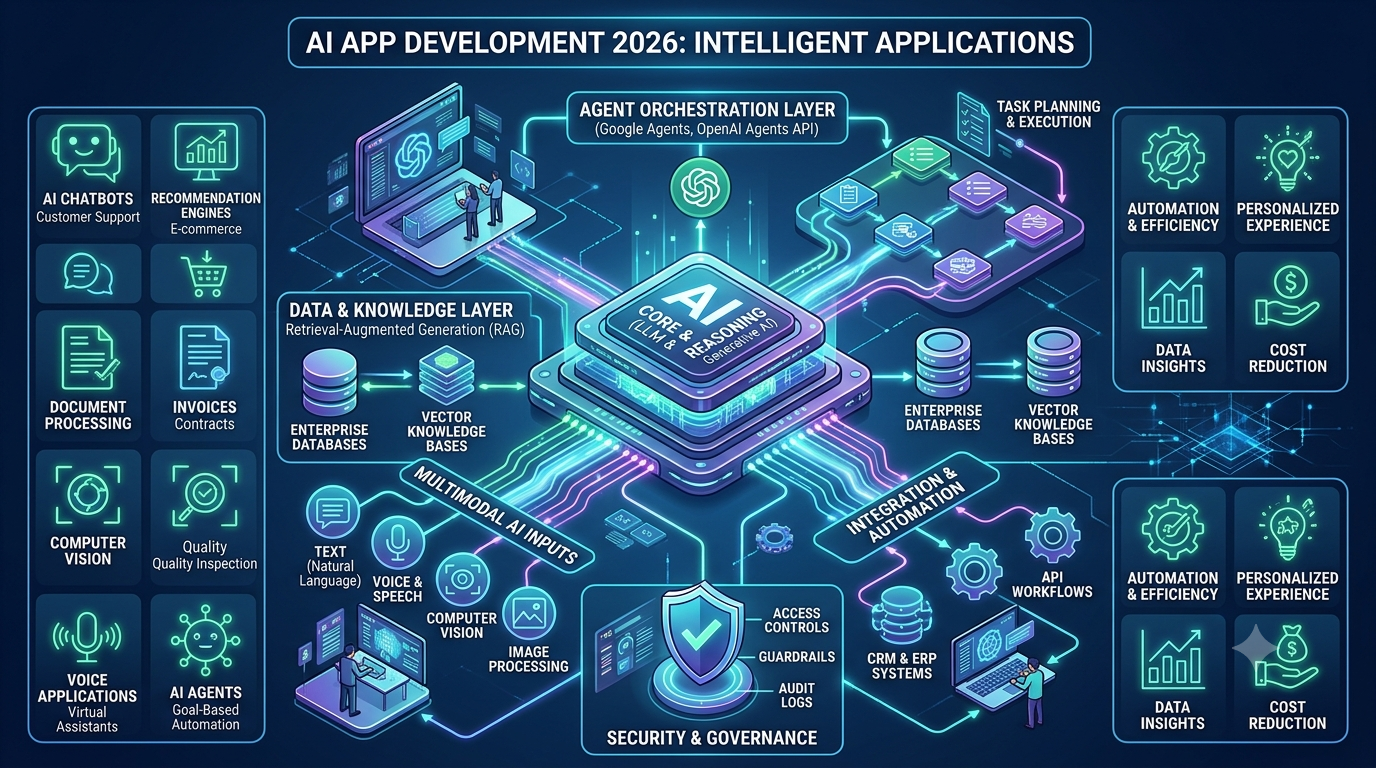
Artificial intelligence is changing the way businesses build and use software.
Traditional applications depend largely on predefined rules and workflows. Modern AI applications can understand natural language, analyze information, generate content, make recommendations, automate tasks, and interact with users in more intelligent ways.
In 2026, AI app development is moving beyond basic chatbots. Businesses are increasingly exploring AI-powered applications, intelligent assistants, recommendation engines, document-processing systems, predictive analytics, and AI agents capable of completing multi-step tasks.
Google’s 2026 developer announcements highlight the growing focus on agent-based application development, including managed agents, AI development tools, and integrations for building production applications.
At the same time, OpenAI introduced its Agents API in September 2026, providing developers with infrastructure for building and running agents that can use tools, work with files, coordinate subagents, and operate across longer-running tasks.
What Is AI App Development?
AI app development is the process of designing and developing applications that use artificial intelligence to perform tasks that traditionally require manual input or predefined programming logic.
An AI application may use:
- Machine learning
- Generative AI
- Large language models
- Computer vision
- Natural language processing
- Speech recognition
- Predictive analytics
- Recommendation systems
- AI agents
- Automation
- Data analytics
For example, an AI customer-support application can understand a user’s question, retrieve relevant information from a company knowledge base, generate an answer, and escalate complex requests to a human employee.
Why Businesses Are Investing in AI Applications
AI is increasingly being incorporated into business applications rather than treated as a separate technology layer.
A 2026 Salesforce report based on more than 4,000 IT leaders describes AI as becoming a foundational part of applications and workflows, while reporting strong developer expectations around AI agents in application development.
Businesses are exploring AI applications to:
- Automate repetitive processes
- Improve customer experiences
- Analyze large datasets
- Personalize services
- Reduce manual work
- Support employees
- Generate business insights
- Improve operational efficiency
- Create new digital products
The objective should not simply be to add AI to an application. The AI functionality should solve a specific business problem.
Types of AI Applications
AI can be incorporated into applications in many different ways.
1. AI Chatbot Applications
AI chatbots can communicate with customers and employees using natural language.
Applications include:
- Customer support
- Internal employee assistance
- Sales support
- Product information
- Technical support
- Frequently asked questions
Modern AI chatbots can be connected to business data and APIs rather than relying only on generic responses.
2. AI Recommendation Applications
Recommendation engines analyze user behavior and other relevant information to provide personalized suggestions.
Examples include:
- E-commerce recommendations
- Content recommendations
- Product suggestions
- Financial insights
- Personalized learning
- Entertainment applications
3. AI Document Processing Applications
Businesses deal with large volumes of documents every day.
AI applications can help extract information from:
- Invoices
- Contracts
- Forms
- Reports
- Receipts
- Insurance documents
- Legal documents
An AI-powered document-processing application can extract relevant information and send it to another business system.
4. AI Computer Vision Applications
Computer vision enables applications to analyze images and video.
Potential use cases include:
- Quality inspection
- Object detection
- Security monitoring
- Medical image analysis
- Retail analytics
- Manufacturing inspection
- Product recognition
5. AI Voice Applications
Voice-enabled applications can combine speech recognition, AI models, and text-to-speech technology.
Businesses can develop AI voice applications for:
- Customer service
- Appointment scheduling
- Virtual assistants
- Sales qualification
- Information systems
- Accessibility
6. AI Agent Applications
AI agents represent an important development in modern application architecture.
Instead of simply answering a question, an AI agent can potentially:
- Understand a goal
- Break the goal into tasks
- Access approved tools
- Retrieve information
- Execute actions
- Evaluate results
- Continue working until the task is completed
Google describes this shift as moving from simple prompts toward AI systems that can orchestrate complex workflows.
OpenAI’s Agents API similarly provides infrastructure for agents that can use tools, maintain context, and coordinate subagents for longer-running tasks.
AI App Architecture
A modern AI application can contain multiple technical layers.
User Interface
The frontend may be a:
- Mobile application
- Web application
- Enterprise dashboard
- Voice interface
- Customer portal
Application Backend
The backend manages:
- Authentication
- Business logic
- APIs
- User permissions
- Data processing
- AI orchestration
AI Model Layer
The application can connect to appropriate AI models for tasks such as:
- Text generation
- Classification
- Summarization
- Image analysis
- Speech processing
- Reasoning
- Data extraction
Knowledge and Data Layer
AI applications often need access to business information.
This can include:
- Databases
- Documents
- Product catalogs
- CRM data
- Knowledge bases
- APIs
- Enterprise systems
Integration Layer
AI applications may connect with:
- CRM platforms
- ERP systems
- Payment systems
- Communication tools
- Cloud services
- Internal APIs
- Third-party applications
Retrieval-Augmented Generation
Retrieval-Augmented Generation (RAG) is commonly used when an AI application needs to answer questions using a company’s own information.
A simplified architecture looks like:
User → AI Application → Retrieval System → Business Data → AI Model → Response
Instead of relying exclusively on information learned during model training, the application can retrieve relevant information from an approved knowledge source and use it to generate a response.
RAG can be useful for:
- Enterprise knowledge assistants
- Customer support
- Technical documentation
- Internal search
- Product information
- Document analysis
AI Agents vs Traditional Chatbots
A traditional chatbot may primarily respond to user questions.
An AI agent can be designed to perform a sequence of actions.
For example:
Customer: “Find my latest order and tell me when it will arrive.”
A traditional system may provide information after predefined inputs.
An agent-based system could potentially:
- Identify the customer
- Access the order-management API
- Retrieve the latest order
- Check shipping information
- Interpret the delivery status
- Generate a response
The exact capabilities depend on the tools, permissions, model, and architecture provided to the agent.
AI App Development Process
Building a reliable AI application requires more than selecting an AI model.
Step 1: Define the Business Problem
Start by identifying the specific problem the application needs to solve.
Questions to consider include:
- Who will use the application?
- What task should AI perform?
- What data is required?
- What systems need to be connected?
- What business outcome is expected?
Step 2: Select the AI Approach
Depending on the problem, developers may choose:
- Generative AI
- Machine learning
- RAG
- Computer vision
- Speech AI
- Predictive analytics
- AI agents
- A combination of technologies
Step 3: Design the Data Architecture
Data quality is critical for AI applications.
Developers need to determine:
- Where data is stored
- How data is accessed
- What data can be used
- How information is secured
- How frequently information changes
Step 4: Design the Application Architecture
The architecture should define how the frontend, backend, AI model, database, APIs, and external systems interact.
Step 5: Develop the AI Features
Developers can implement capabilities such as:
- AI chat
- Search
- Summarization
- Classification
- Recommendations
- Document processing
- Agents
- Automated workflows
Step 6: Integrate Business Systems
AI becomes more useful when it can securely interact with existing business systems.
Examples include:
- CRM
- ERP
- Inventory
- Payment
- HR
- Customer-support platforms
Step 7: Test the Application
Testing should evaluate both software functionality and AI behavior.
Testing can include:
- Accuracy
- Response quality
- Security
- Latency
- API reliability
- Permission controls
- Failure handling
- Prompt injection resistance
- Data privacy
Step 8: Deploy and Monitor
After deployment, developers should monitor:
- Usage
- Cost
- Response quality
- Latency
- Errors
- User feedback
- Security events
AI applications may require continuous improvement after launch.
Security in AI App Development
Security should be considered during architecture and development rather than added at the end.
Important areas include:
- User authentication
- Authorization
- Data encryption
- API security
- Access controls
- Secure data storage
- Audit logs
- Model access controls
- Prompt injection protection
- Sensitive-data handling
Agentic applications introduce additional security considerations because an AI system may have access to tools and external systems.
Google has emphasized that agentic software changes security requirements because systems can interpret intent, use tools, and take actions.
For enterprise applications, developers should carefully define what an AI system is allowed to access and which actions require human approval.
AI App Development for Different Industries
AI applications can be developed for almost every major industry.
Healthcare
Potential applications include:
- Patient-support tools
- Medical documentation
- Appointment systems
- Healthcare analytics
- Administrative automation
Healthcare applications require particularly careful handling of privacy, security, and regulatory requirements.
Finance
AI can support:
- Financial analysis
- Customer service
- Document processing
- Fraud detection
- Risk analysis
- Internal automation
Retail
Retail businesses can use AI for:
- Product recommendations
- Customer support
- Inventory insights
- Personalized experiences
- Sales analysis
Manufacturing
Manufacturers can explore AI applications for:
- Predictive maintenance
- Quality inspection
- Production analytics
- Supply-chain optimization
- Industrial monitoring
Education
AI applications can support:
- Personalized learning
- Educational assistants
- Automated content generation
- Student support
- Learning analytics
AI App Development Trends in 2026
Several developments are shaping AI application development in 2026.
Agentic Applications
AI applications are increasingly being designed to complete multi-step tasks rather than only generate responses. Google and OpenAI are both providing developer infrastructure aimed at agent-based applications.
Multimodal AI
Applications can increasingly combine text, images, audio, and other forms of information.
This enables more natural user experiences and broader business use cases.
AI + Automation
Businesses are combining AI reasoning with traditional software automation.
For example:
AI → Understand Request → Call API → Process Data → Update System → Notify User
Enterprise AI
Businesses are increasingly connecting AI applications with internal data and existing enterprise systems.
This makes data governance, permissions, security, and integration architecture increasingly important.
AI-Powered Software Development
AI-assisted development is also becoming a major part of the software-development ecosystem. Recent investment in AI coding-agent companies reflects growing enterprise interest in AI-assisted engineering workflows.
How Much Does AI App Development Cost?
The cost of developing an AI application depends on its functionality and technical architecture.
Factors that influence cost include:
- Application complexity
- Number of platforms
- AI model requirements
- API usage
- Data volume
- RAG implementation
- AI agent functionality
- Third-party integrations
- Security requirements
- Cloud infrastructure
- Development team
- Testing requirements
- Ongoing maintenance
A simple AI-enabled application can require significantly less development work than an enterprise AI platform with multiple integrations, custom workflows, and agent capabilities.
Therefore, businesses should define the required functionality before estimating development costs.
Why Choose Custom AI App Development?
Off-the-shelf AI tools can be useful for common tasks, but custom development provides greater control over the application.
A custom AI application can be designed around:
- Specific business workflows
- Proprietary data
- Existing software
- Custom user experiences
- Security requirements
- Industry requirements
- Internal APIs
- Enterprise processes
This can make custom development particularly relevant for companies building AI-powered products as part of their core business.
Conclusion
AI app development is moving from simple chatbot experiences toward intelligent applications capable of understanding information, using business data, interacting with software systems, and completing multi-step workflows.
In 2026, AI agents, generative AI, RAG, multimodal models, automation, and enterprise integrations are becoming important parts of modern AI application architecture.
For businesses planning an AI-powered product, the key is not simply choosing the latest AI model. The application needs a well-designed combination of AI models, data, software architecture, APIs, security, user experience, and business workflows.
A carefully planned AI application can provide a foundation for automation, intelligent decision support, personalized experiences, and new digital products.
Frequently Asked Questions
What is AI app development?
AI app development is the process of building applications that use artificial intelligence technologies such as generative AI, machine learning, computer vision, NLP, or AI agents.
What is an AI agent?
An AI agent is a software system designed to understand a goal, reason through tasks, use available tools, and perform actions according to its instructions and permissions.
Can AI be added to an existing application?
Yes. AI functionality can often be integrated into existing web, mobile, and enterprise applications through APIs, AI models, RAG systems, or custom machine-learning components.
What is RAG in AI applications?
RAG, or Retrieval-Augmented Generation, allows an AI application to retrieve relevant information from an external knowledge source and use that information when generating a response.
How long does it take to develop an AI application?
The timeline depends on the application’s functionality, integrations, AI architecture, data requirements, security needs, and testing requirements.
Is custom AI app development suitable for businesses?
Custom AI development can be useful when a business needs AI functionality tailored to specific workflows, proprietary data, integrations, or industry requirements.
Primary Keyword: AI App Development
Secondary Keywords:
AI App Development Company, AI Application Development, AI App Developers, Custom AI App Development, AI Software Development, AI Agent Development, Generative AI App Development, Enterprise AI Development, AI Application Development Services, AI Development Company
SEO Title:
AI App Development in 2026: Build Intelligent AI-Powered Applications
Meta Description:
Explore AI app development in 2026, including AI agents, generative AI, RAG, application architecture, use cases, development process, security, and costs.
Suggested URL Slug:/ai-app-development/