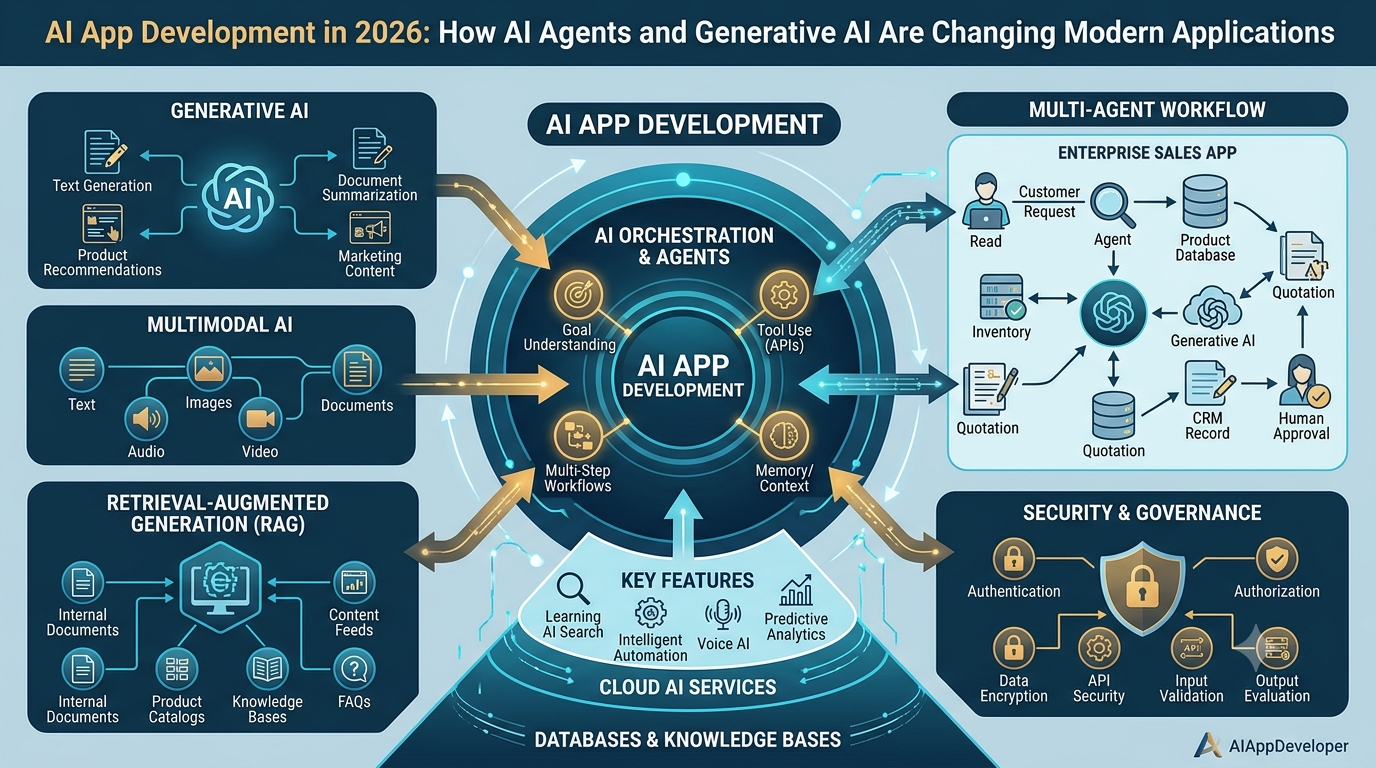
Artificial intelligence is changing the way modern software is designed, developed, and used. In 2026, businesses are moving beyond basic chatbots and experimenting with applications that can understand context, generate content, analyze data, automate workflows, and take actions on behalf of users.
This shift is creating demand for AI app development that combines large language models, machine learning, generative AI, AI agents, APIs, cloud platforms, and traditional application architecture.
For startups and enterprises, the opportunity is no longer simply to “add AI” to an existing application. The bigger opportunity is to build software around intelligent workflows from the beginning.
What Is AI App Development?
AI app development is the process of creating mobile, web, or enterprise applications that use artificial intelligence to perform tasks such as prediction, personalization, automation, natural-language interaction, recommendation, content generation, and decision support.
An AI-powered application can combine:
- Generative AI
- Large language models
- Machine learning
- Natural language processing
- Computer vision
- Speech recognition
- AI agents
- Retrieval-augmented generation (RAG)
- Cloud AI services
- Business APIs
- Databases and knowledge bases
A modern architecture can connect the user interface with AI models, business data, APIs, and automation systems to produce either an intelligent response or an actual business action.
Why AI App Development Is Growing in 2026
AI is increasingly becoming part of mainstream application development. Salesforce’s 2026 IT research reports that nearly 40% of new applications already include AI features, while AI agents are increasingly being incorporated into business and IT workflows.
At the same time, Gartner projects worldwide spending on AI models and platforms to reach approximately $64 billion in 2026, with particularly strong growth in specialized generative AI models and AI application development platforms.
This growth is encouraging businesses to explore AI applications for:
- Customer service
- Healthcare
- Finance
- Retail
- E-commerce
- Education
- Marketing
- Logistics
- Manufacturing
- Enterprise operations
- Productivity
AI Agents Are Becoming a Major Part of AI Applications
One of the biggest changes in AI application development is the transition from conversational systems to AI agents.
A traditional chatbot may answer a customer’s question.
An AI agent can potentially understand a goal, retrieve information, use connected tools, perform multiple steps, and complete an approved task.
For example, an enterprise sales application could allow an AI agent to:
- Read a customer request.
- Search the company’s product database.
- Check inventory.
- Generate a quotation.
- Update a CRM record.
- Send the quotation for human approval.
Google Cloud identifies agentic workflows and multi-agent collaboration as important areas of AI development in 2026.
This makes AI agent development an important consideration for companies building next-generation applications.
Generative AI Is Moving Beyond Chatbots
Generative AI has become one of the most visible components of modern AI software.
Businesses can integrate generative AI into applications for:
- Text generation
- Document summarization
- Product recommendations
- Marketing content
- Code assistance
- Knowledge search
- Customer support
- Data analysis
- Report generation
- Personalized experiences
However, successful generative AI applications require more than connecting an app to an AI model.
The application also needs reliable data, appropriate prompts, access controls, monitoring, evaluation, and integration with business systems.
Multimodal AI Applications
Another important development is multimodal AI.
Instead of working only with text, multimodal applications can process combinations of:
- Text
- Images
- Audio
- Video
- Documents
- Structured business data
For example, an insurance application could allow a user to upload an image of vehicle damage and provide additional information through voice or text.
A healthcare application could combine documents, images, and structured patient information to assist authorized professionals.
This opens new opportunities for AI application development across industries.
Retrieval-Augmented Generation for Business Applications
For enterprise applications, AI responses often need to be based on company-specific information.
This is where Retrieval-Augmented Generation (RAG) can become useful.
A RAG-based application can retrieve relevant information from approved business sources before generating a response.
Possible sources include:
- Internal documents
- Product catalogs
- Knowledge bases
- FAQs
- Databases
- Policies
- Technical documentation
- Customer records
This approach can help businesses build AI applications that are more closely connected to their own information rather than relying solely on a general-purpose model.
AI-Powered Personalization
Modern applications can use AI to create more personalized experiences.
For example, an e-commerce application can analyze user interactions and recommend products based on browsing behavior, purchase history, preferences, and other permitted signals.
Similarly, an education application can personalize learning content according to a student’s progress.
AI personalization can be applied to:
- Product recommendations
- Search results
- Content feeds
- Learning paths
- Marketing campaigns
- Customer support
- User interfaces
AI-Native Application Architecture
AI is also influencing application architecture itself.
Instead of treating AI as a small feature inside an otherwise traditional application, businesses can design applications around AI-driven workflows.
A modern AI application may include:
User Interface → Application Backend → AI Orchestration → Model/API Layer → Business Data → External Tools
This architecture can support AI agents, RAG pipelines, multiple models, business APIs, analytics, and automation.
SAP’s 2026 analysis describes this broader movement toward AI-native architecture, where applications increasingly combine AI capabilities with business data, reasoning, and workflows.
Key Features of Modern AI Applications
Businesses considering custom AI app development can explore features such as:
1. AI Chat Interfaces
Natural-language interfaces allow users to interact with applications using conversational commands.
2. AI Search
Users can search business information using natural-language questions instead of traditional keywords.
3. AI Recommendations
Machine learning can analyze permitted user and business data to generate personalized recommendations.
4. Intelligent Automation
AI can automate repetitive workflows and route tasks between systems.
5. AI Agents
Agents can coordinate multiple steps and interact with approved APIs and tools.
6. Voice AI
Voice interfaces can enable hands-free interaction with mobile and web applications.
7. Computer Vision
Image and video analysis can support applications in retail, manufacturing, healthcare, security, and logistics.
8. Predictive Analytics
Machine learning models can identify patterns and generate forecasts from historical data.
Security Should Be Built Into AI App Development
AI applications often interact with sensitive business and customer information. Security therefore needs to be considered during architecture and development rather than added at the end.
Important areas include:
- Authentication
- Authorization
- Data encryption
- API security
- Access controls
- Prompt and input validation
- Model monitoring
- Data privacy
- Audit logging
- Human approval for high-impact actions
- AI output evaluation
AI adoption is also increasing the importance of governance and security because organizations need visibility into how AI systems access data and perform actions.
How to Build an AI Application in 2026
A practical AI app development process can include the following stages.
Step 1: Define the Business Problem
Start with the problem rather than the AI model.
Determine what the application needs to improve, automate, predict, or simplify.
Step 2: Identify the AI Use Case
Decide whether the application requires:
- Generative AI
- Machine learning
- Computer vision
- Voice AI
- AI agents
- RAG
- Predictive analytics
- A combination of technologies
Step 3: Prepare the Data
Data quality has a major impact on AI application performance.
Businesses should identify the required data sources, remove unnecessary duplication, establish access controls, and create appropriate data pipelines.
Step 4: Select the AI Architecture
Choose the appropriate combination of models, APIs, databases, cloud infrastructure, orchestration, and application components.
Step 5: Build the MVP
Develop a focused version of the application around the most important use case.
This makes it easier to test usability, AI performance, security, and business value.
Step 6: Integrate Business Systems
AI applications often become more useful when they connect with existing:
- CRM systems
- ERP platforms
- Payment systems
- Databases
- E-commerce platforms
- Communication tools
- Enterprise APIs
Step 7: Test and Evaluate
AI applications require testing beyond traditional software testing.
Teams should evaluate:
- Accuracy
- Reliability
- Response quality
- Latency
- Security
- Cost
- Hallucination risk
- User experience
Step 8: Deploy and Monitor
After deployment, continuously monitor application performance, model behavior, infrastructure costs, security events, and user feedback.
AI App Development for Startups and Enterprises
The requirements of an AI startup can differ significantly from those of a large enterprise.
A startup may prioritize:
- Faster MVP development
- Product-market validation
- Scalable architecture
- Lower initial infrastructure costs
- Rapid experimentation
An enterprise may require:
- Existing system integration
- Advanced security
- Data governance
- Role-based access
- Compliance requirements
- Monitoring
- Multi-model architecture
- Enterprise scalability
A capable AI app development company should therefore design the technology stack around the application’s actual requirements rather than forcing every project into the same architecture.
How Much Does AI App Development Cost?
The cost of AI app development depends on several factors, including:
- Application complexity
- Number of platforms
- AI model requirements
- Custom machine learning
- AI agent functionality
- RAG implementation
- Third-party API integrations
- Cloud infrastructure
- Security requirements
- Data engineering
- UI/UX complexity
- Testing and maintenance
A simple AI-enabled application and a large enterprise AI platform can have completely different development requirements.
For this reason, businesses should first define the product scope and technical architecture before estimating the development budget.
The Future of AI App Development
The next phase of AI application development is likely to focus increasingly on intelligent agents, specialized models, multimodal systems, AI-native architecture, and applications capable of completing multi-step workflows.
Gartner highlights agentic AI, multimodal capabilities, domain-specific models, and smaller reasoning models as important emerging directions for generative AI.
For businesses, the key question is becoming less about whether AI should be used and more about where AI can create measurable value inside the product or workflow.
Build Your AI Application With AIAppDeveloper
Developing a successful AI application requires more than connecting an API to a chatbot interface.
The right solution combines AI app development, software engineering, data architecture, AI model integration, user experience, security, and scalable infrastructure.
AIAppDeveloper can help businesses explore and build intelligent applications around their specific requirements, from AI-powered features and generative AI applications to intelligent automation and AI agent solutions.
If you are planning an AI product in 2026, start with the business problem, define the AI use case, and build an architecture that can scale with your product.
SEO Keywords
Primary Keyword: AI app development
Secondary Keywords:
AI app development company, AI application development, AI app developers, custom AI app development, AI software development, AI agent development, generative AI app development, AI-powered applications, machine learning app development, AI mobile app development, AI web application development, multimodal AI development, RAG application development, enterprise AI development, AI chatbot development, AI automation solutions, AI development services.
Suggested SEO Title
AI App Development in 2026: AI Agents, Generative AI & More
Meta Description
Explore AI app development in 2026, including AI agents, generative AI, RAG, multimodal applications, personalization, automation, security, and enterprise AI solutions.
Suggested URL
/blogs/ai-app-development-2026-ai-agents-generative-ai/
Suggested Internal Backlinks
- AI app development → AIAppDeveloper.ai
- AI app development company → AIAppDevelopers.ai
- AI agent development → relevant AI service page
- custom AI app development → relevant development/service page
- AI software development → Quartus Technology
- IoT AI solutions → BLEIoT / IoTBLE
- custom POS software development → CustomPOS Developers